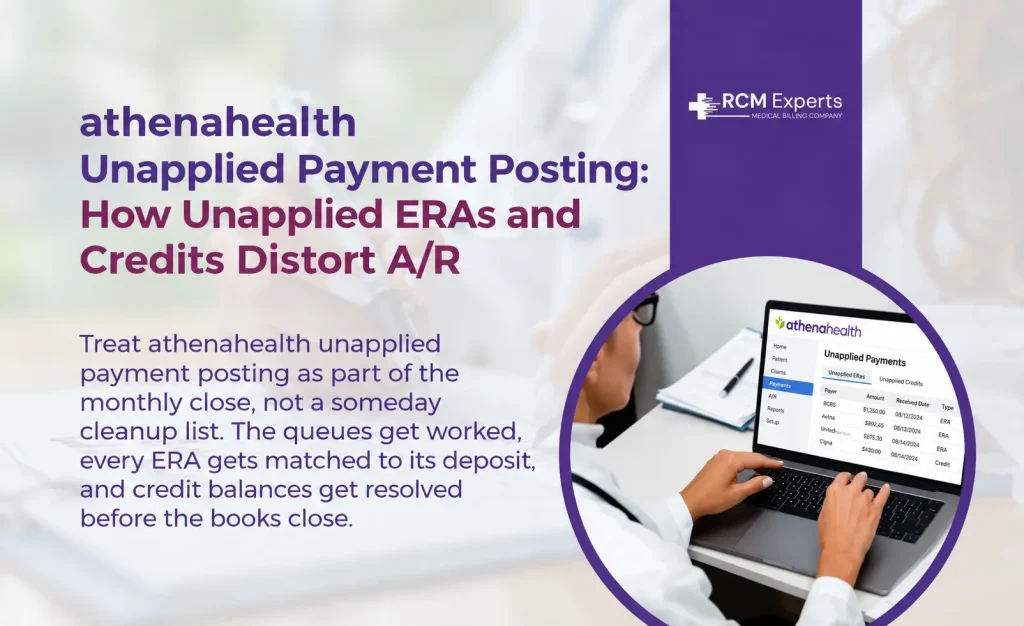
Treat athenahealth unapplied payment posting as part of the monthly close, not a someday cleanup list. Your team works the queues, matches every ERA to its deposit, and resolves credit balances before the books close. Why so strict? Unapplied cash and false credits can push accounts receivable in either direction, and the monthly financials say nothing real about the practice until you clear them.
Few practices catch this directly. What they catch instead is a gap between cash collected and A/R that nobody in the room can explain. The sections below trace that gap to its sources, show what it does to the month-end numbers, and lay out the routine that closes it.
Key Takeaways
- An unapplied ERA in athenahealth is cash the practice has received but has not tied to a specific charge.
- Bulk ERA files, deposit exceptions, and patient prepayments are the three main sources of unapplied cash.
- Unapplied cash and misallocated credits distort A/R, net collections, and month-end reports in opposite directions, which is why the totals can look fine while the accounts are wrong.
- Credit balances carry real obligations, including patient refunds, state unclaimed property duties, and the Medicare 60-day repayment rule.
- Review unapplied balances by age, not just by volume, and work the oldest items first.
- Reconciliation works best on a fixed monthly schedule with a named owner.
- Clean, audit-ready statements require every deposit to match a posted remittance.
Last updated: October 25, 2026
Where Unapplied Cash Comes From in athenaNet
Unapplied cash is money in the bank that the system has not attached to a charge. It sits on the account as a balance with no claim behind it. Three sources produce most of it.
Bulk ERA Files
Payers often send one electronic remittance that covers many patients and many claims. athenaNet usually matches bulk ERAs automatically. Not every line matches. A claim number may not line up, the payer may list a patient under a different ID, or the payer may pay a claim the system no longer shows as open. Those lines post as unapplied or drop into a review queue.
Deposit Workflow Exceptions
Athenahealth deposit workflow exceptions occur when the bank deposit and the remittance do not agree. A paper check may arrive without its explanation of benefits. An EFT may land weeks before its ERA. A payer may combine several remittances into one transfer. Each of these leaves cash on the books without the detail your team needs to post it.
Patient Prepayments and Copays
Front-desk collections create the most frequent small balances. Athenahealth copay allocation rules determine whether a time-of-service payment attaches to the visit or sits on the patient’s account. When the front desk collects a copay before the visit is billed, or leaves the payment unapplied, the money floats. If the claim later pays in full, that copay becomes a credit.
Common Causes of Unapplied Cash in athenahealth
| Cause | How it shows up | Effect on the books |
|---|---|---|
| Unmatched bulk ERA lines | Remittance lines in a review or unapplied queue | Cash recorded, A/R not reduced |
| EFT received before ERA | Deposit with no remittance detail | Unposted cash on the deposit report |
| Paper check without EOB | Check logged with no charge-level detail | Cash sits as unapplied payment |
| Copay left on account | Patient balance shows unapplied amount | Patient A/R understated or credit created |
| Duplicate or overpayment | Payment exceeds the allowed amount | False credit balance on the account |
| Payer recoupment offset | Negative line against a new payment | Mismatched deposit and posted totals |
How Credit Balances Distort A/R and Monthly Financials
Unapplied cash does not disappear. It changes what the reports say.
When payer cash sits unapplied, the claim it belongs to still shows as open. A/R looks higher than it is. Days in A/R rise. The practice may chase a claim the payer has already paid.
Misallocated patient payments cut the other way. Now the account carries a credit, and in aggregate A/R reports credits net right against debits. Stack enough false credits together and they bury real unpaid balances under a number that looks far healthier than it should.
Both errors can exist at once. The totals may look reasonable while individual accounts are wrong. That is the blind spot. An owner sees cash collected that does not reconcile to the change in A/R and has no clear reason why.
The effect reaches past A/R. Net collection rates, payer mix reports, and provider productivity reports all depend on payments posted to the right charges. Unapplied cash weakens every one of them.
Summary reports net credits against debits, so a balance that looks perfectly normal can hide thousands in false credits sitting next to real unpaid claims.
Where It Shows Up at Month End
This is also the point where the problem stops being a billing matter and becomes an accounting one. The bank statement is right. The posted payments are right. The two do not agree, because the difference is sitting unapplied.
A practice that ties bank deposits to posted payments every month finds this in a single step. A practice that does not will find it in the annual review, by which time the research is much harder and some of the credits have aged into refund obligations.
If you want this handled every month, hand the work to specialists. Our team provides athenahealth billing services that include ERA matching, deposit reconciliation, and credit balance resolution.
The Risks Behind Credit Balances
A credit balance is not money earned. More often than not, the practice owes it back to someone.
Patient Statements
Unresolved credits confuse patients. A patient may receive a statement that shows a credit on one visit and a balance on another. That leads to calls, disputes, and delayed payment. Applying the credit to an open balance, when allowed, or issuing a refund keeps statements accurate. For the wider patient-balance workflow this sits inside, see our guide to managing patient A/R in athenahealth.
Deciding Who Gets the Money
Before you send any refund, establish who the practice actually owes. A credit on the account does not tell you this on its own.
- If a payer overpaid, the money goes back to that payer.
- If two payers both paid as primary, the practice usually owes the refund to the secondary payer, not the patient.
- If coordination of benefits was wrong, the practice may owe the correct primary payer, and may need to rebill the claim rather than refund it.
- If the patient overpaid, or paid a copay that insurance later covered in full, the practice owes the patient.
- If the credit arose from a posting error rather than a real overpayment, the practice owes nobody — correct the posting instead.
Refunding the wrong party creates a second problem on top of the first, and recovering the money is harder the second time.
Refund Obligations
Returning a patient credit is a legal and contractual duty first, good service second. Refund timelines live in the payer contracts, and our guide to credit balances, refunds and compliance covers how that process runs across payers.
State law adds a second obligation that practices routinely miss. Most states apply unclaimed property law to money a practice cannot return to its owner. A patient credit that sits unrefunded — because the patient moved, the address is stale, or nobody acted — does not simply age out. After a dormancy period set by state law, the practice generally has to report and remit it to the state. Dormancy periods and reporting deadlines vary by state, so confirm the rule for each state the practice operates in.
The practical consequence is simple. A credit balance left alone does not become less of a problem with time. It becomes a different one.
Overpayment Compliance
The government side is strictest. Under the CMS final rule on reporting and returning overpayments, a Medicare Part A or Part B provider who identifies an overpayment must report and return it within 60 days of identification, with a six-year lookback period.
Two details make that rule usable rather than alarming.
CMS treats an overpayment as identified once the provider has quantified the amount, not at the first hint something may be wrong. And the rule allows a period of reasonable diligence — a timely, good-faith investigation — before the 60-day clock starts, generally understood as up to six months from receiving credible information, absent extraordinary circumstances.
That is the point of a monthly credit review. It converts an open-ended compliance exposure into a scheduled task, and it means you use the diligence period rather than discover it after the fact. An unreviewed credit balance can hide an overpayment nobody has identified yet, and the rule does not accept “we never looked” as a reason the clock never started.
Full detail is in the federal overpayment regulation and CMS’s guidance on reporting and returning overpayments.
How to Work the Unapplied Queues and Reconcile Deposits
The routine runs in a fixed order: queues first, deposits second, credits last. Within each stage, work oldest first — old items are harder to research, more likely to have become obligations, and the ones you are most likely to write off if you leave them any longer.
The Reconciliation Flow
From remittance arrival to a reviewed credit balance, the order that keeps the month closeable.
- ERA arrives
- Auto-match runs against open claims
- Exceptions land in the review queue
- Staff research and post unmatched lines
- Staff compare the deposit to posted remittances
- Staff chase down variances
- Staff mark the deposit reconciled
- Staff review credit balances
Step One: Work the Queues
Start with the unapplied balances, and work them daily or weekly at minimum. Narrow the list to the items your own team can act on, so the queue reflects work that is actually yours to do. Where the backlog is a throughput problem rather than an exception problem, our guide to speeding up insurance payment posting in athenahealth deals with the upstream cause.
Research each line against the payer portal or the paper EOB. Post it to the correct claim, or document why you can’t post it and what you need to resolve it. An item you can’t post today still needs a note explaining what it is waiting on.
Step Two: Reconcile Deposits
Compare each bank deposit to the posted remittances for that deposit. EFTs should match ERA totals. Checks should match their EOBs. Any difference is a variance to resolve before the month closes.
Where a deposit has no remittance behind it at all, chase the remittance rather than waiting for it. The payer portal is usually faster than waiting for the file to arrive.
Step Three: Review Credits
Split payer credits from patient credits, then sort each one into a true overpayment, a misallocation, or plain timing. Move misallocated payments to the charge they belong on. Run true overpayments through the payee determination above, then refund them.
A credit caused by a payment posted before its charge often clears on its own. Confirm the cause before you issue a refund.
Set a Write-Off Policy Before You Need One
Every reconciliation process eventually meets a residual balance too small to be worth researching. Without a policy, these accumulate; with one, they clear.
A workable policy names three things: the maximum amount staff may write off without approval, the minimum age before a balance qualifies, and who signs off. Set the figures to the practice’s own volume and cost of staff time rather than to a published benchmark, and document them. Note that a de minimis policy applies to residual balances, not to identified Medicare overpayments, which you must return regardless of size.
Assign One Owner
Assign one person to this process. Shared ownership usually means no ownership. The owner keeps the schedule, works the queues in order, and reports the month-end variance — including when it is zero.
Monthly Reconciliation Checklist
| Step | What to compare | What clean looks like |
|---|---|---|
| Clear unapplied queue | Unapplied payments vs. open claims | Queue empty or each item documented |
| Match ERAs to deposits | ERA totals vs. EFT amounts | Every EFT tied to a posted ERA |
| Match checks to EOBs | Check amounts vs. posted EOB totals | No unposted paper checks |
| Review patient credits | Patient credits vs. open patient balances | Credits applied or refunded |
| Review payer credits | Payer credits vs. remittance history | Overpayments reported and returned |
| Tie bank to system | Bank deposits vs. posted payments | Variance at zero or explained |
| Apply write-off policy | Residual balances vs. policy thresholds | Qualifying items cleared and logged |
| Check the aging | Oldest unapplied item vs. internal target | Nothing unapplied beyond the practice’s own limit |
A Worked Example
The figures below are illustrative. They show the shape of the problem rather than a benchmark.
- A bulk ERA arrives for $18,400 covering 40 claimsThirty-seven lines auto-match and post against open claims. Three do not: the payer lists one patient under a prior member ID, one claim had already closed, and one line carries a recoupment offset against an earlier overpayment.
- The deposit does not tieThe bank shows $18,400. Posted payments show $17,050. The $1,350 difference is the three unmatched lines, sitting unapplied. A/R still shows those three claims as open, so A/R overstates the balance by roughly the same amount and days in A/R drift upward for reasons no report explains.
- Resolution splits three waysThe member-ID line posts once staff match the patient correctly. The closed-claim line turns out to be a duplicate payment, producing a genuine credit that goes to payee determination and then refund. The recoupment line is not a payment at all, so staff net it against the original overpayment. Only after staff work all three does the deposit tie to zero.
One ERA, three exception types, three different resolutions. Multiply by the number of remittances a practice receives in a month and the case for a scheduled routine makes itself.
How to Stop the Queue Refilling
Working the queue is recovery. Keeping it short is prevention, and prevention is cheaper.
Capture copays against the visit, not the account. A payment attached to a specific visit cannot float. Where the visit is not yet billed, flag the payment for review rather than leaving it to settle on its own.
Set a rule for patient prepayments. Prepayments for scheduled procedures are the most common source of aged patient credits. Decide in advance how you hold them and when you apply them, and review them when you bill or cancel the procedure.
Retrieve missing remittance rather than waiting for it. When an EFT lands without its ERA, pull the remittance from the payer portal. Waiting turns a same-week reconciliation into month-end research.
Watch the recurring causes. If the same payer produces unmatched lines every month, that is a setup or enrolment problem, not a posting problem. Track unmatched items by payer and reason, and fix the repeat offenders at the source.
Reconcile deposits weekly, not monthly. The research is easy while the detail is recent and hard once it is not.
For practices where the recurring cause is denials rather than posting, our denial management services for athenahealth providers address the upstream side of the same problem.
What Clean, Audit-Ready Statements Require
Three things, and the first is the whole job.
A full match. Every dollar in the bank traces to a posted payment, and every posted payment traces to a charge. Nothing floats.
Documentation that holds up. Refunds, adjustments and write-offs each need a reason and a date on record. Auditors want a trail they can walk, not a total on a page.
Timeliness. Review credits every month, not once a year. The 60-day rule above is the reason this matters for Medicare, and the same discipline is what keeps commercial credits from aging into unclaimed property.
Medicare Part A facilities carry one additional obligation: they file a quarterly credit balance report on CMS form 838, listing Medicare credits on hand. This applies to Part A institutional providers — ambulatory practices billing Part B do not file it, though the underlying duty to identify and return overpayments applies to both. Where the quarterly filing does apply, a monthly credit review turns it into routine paperwork rather than a quarterly scramble.
Conclusion
Left alone, unapplied ERAs and misallocated patient credits open a gap between cash and A/R. The gap hides where the practice actually stands, and tucked inside it sit refund and compliance risks that only grow with time.
The fix is dull on purpose. Work the queues oldest first, match each deposit to its remittance, and give the credits their monthly review until you resolve every one. Name an owner, write down the thresholds, and prevent the recurring causes rather than reworking them.
Practices that prefer to hand the routine to a dedicated team end up with clean, audit-ready statements every month and no extra internal hires.
Close the month without unexplained cash
Our team works the unapplied queues, ties every deposit to its remittance, and resolves credit balances on a fixed monthly schedule — so the statements reconcile before you need them to.
Explore athenahealth billing servicesFAQs
It is cash that athenaNet has recorded but nobody has tied to a specific charge. It often comes from unmatched ERA lines, deposits without remittance detail, or patient payments left on the account. Until your team applies it, it distorts A/R.
Unapplied payer cash leaves paid claims open, which inflates A/R. Misallocated patient payments create credits that offset real balances. Both cause cash and A/R to move in ways that do not line up, and because the two errors work in opposite directions the totals can look reasonable while individual accounts are wrong.
Work them daily or weekly, and complete a full reconciliation at least once a month before closing the books. Short cycles keep research simple because the details are still fresh.
No. Some credits are timing issues or misallocated payments that clear once you post them correctly. Others are true overpayments that you must refund. Review the cause of each credit before acting, and establish who the practice owes before issuing any refund.
Sixty days from the point you identify the overpayment, meaning once you have quantified the amount, with a six-year lookback. The rule also allows a reasonable period of good-faith investigation before that clock starts. A scheduled monthly credit review is what keeps a practice inside both windows.
Generally you cannot simply keep it. Most states treat unreturned patient money as unclaimed property, which the practice must report and remit to the state after a dormancy period set by state law. Confirm the rule for each state the practice operates in.
A dedicated team works the queues, matches deposits to remittances, and resolves credits on a fixed schedule. The practice receives clean, reconciled financial statements each month, and staff time shifts back to patient-facing work.