[VERIFY: author name and credential, supplied by RCM Experts] · Reviewed by [VERIFY: certified coder or billing manager name and credential, supplied by RCM Experts]
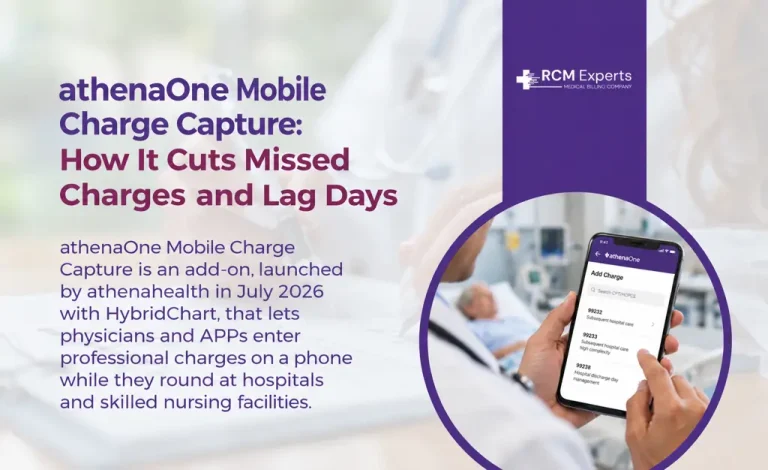
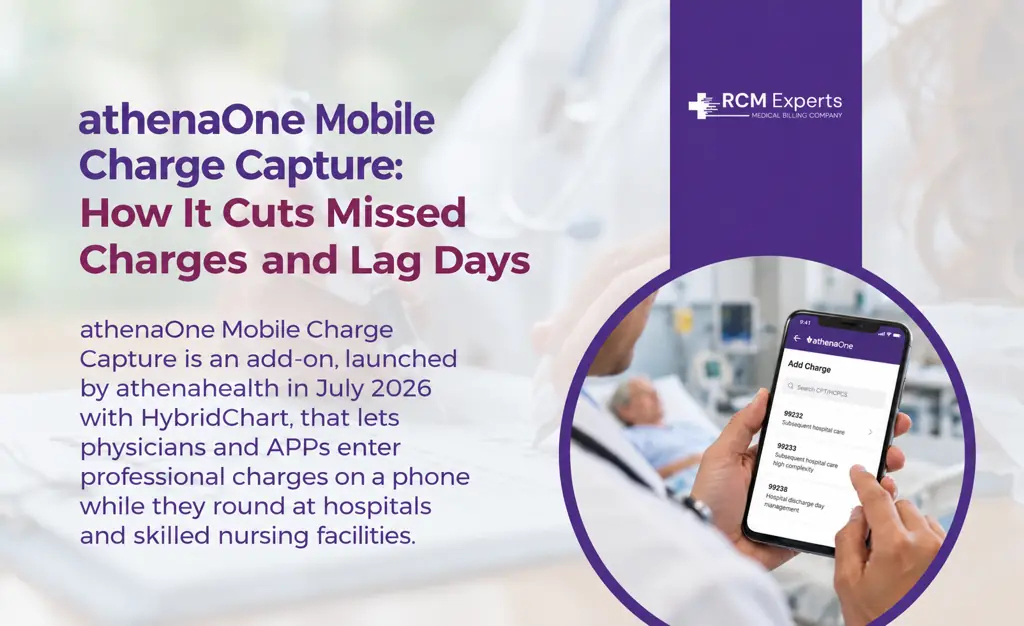
athenaOne Mobile Charge Capture is an add-on, launched by athenahealth in July 2026 with HybridChart, that lets physicians and APPs enter professional charges on a phone while they round at hospitals and skilled nursing facilities. The charges flow straight into athenaOne billing. It reduces missed charges and lag days by removing the step where they usually go wrong: the paper card or memory that someone keys in hours or days later.
It only helps if the athenaOne setup underneath is clean, and you only know it helped if you measured your lag before go-live. The sections below cover both.
Key Takeaways
- Mobile Charge Capture is a separate add-on to athenaOne, offered through athenahealth’s Alliance Partnership with HybridChart. athenahealth built it for rounding outside the clinic, not for office visits.
- Practices lose rounding charges in the gap between the visit and the keying. Capturing the charge at the bedside closes that gap.
- Faster capture also means faster errors. Get providers, facilities, place of service and the code menu right in athenaOne before the first charge flows.
- The vendor-reported 8–10% revenue gain is a starting claim, not a promise. Measure your own charge lag and missed charges before and after go-live.
- Charge lag and claim lag are different numbers. Mobile capture shortens the first; charge review and claim rules control the second.
- A daily census-to-charges reconciliation is still the control that proves nothing was missed.
Last updated: October 25, 2026
What athenaOne Mobile Charge Capture Is
athenahealth announced Mobile Charge Capture on July 28, 2026 as an add-on capability for athenaOne. athenahealth offers it through its Alliance Partnership with HybridChart, a rounding and charge-capture app that already served athenaOne practices. athenahealth said nearly 70 customers were using it for rounding and charge capture at launch, across specialties including cardiology, orthopedics and gastroenterology. [VERIFY: launch date, partner name and customer count against the athenahealth press release of July 28, 2026]
athenahealth built the product for ambulatory practices whose clinicians also see patients outside the office: hospital inpatients and observation patients, consults, and skilled nursing or nursing facility residents. Clinicians search for patients through athenaOne, keep a rounding list, and select charges from a menu that mirrors the practice’s athenaOne billing codes. The charge then flows into athenaOne’s billing workflow without anyone re-keying it. [VERIFY: current feature set and charge flow against the athenahealth Marketplace listing and HybridChart documentation for the 2026 add-on]
Two things it is not:
- It is not the office-visit workflow. Clinic encounters still close and drop charges through the normal athenaOne encounter.
- It is not included by default. athenahealth sells it as an add-on and doesn’t publish pricing, so ask your athenahealth representative. [VERIFY: whether the add-on is licensed per provider, per practice or otherwise]
Why Rounding Charges Go Missing
In the clinic, the encounter and the charge live in the same system. On rounds, they usually don’t. The traditional rounding workflow looks like this:
- The physician sees the patient in the hospital and documents in the hospital’s EHR.
- The physician writes the charge on an index card, a printed census, a spreadsheet or a phone note.
- The card or list reaches the billing office at the end of the day, the end of the week, or whenever the physician remembers.
- A biller keys the charge into athenaOne, often without the hospital note in front of them.
Every hand-off in that chain gives a charge a chance to disappear: a card left in a coat, a weekend of consults that never made the list, a discharge day nobody recorded, an illegible code. The delay causes its own damage. The later someone keys a charge, the further it sits from the documentation, and the closer it gets to the payer’s filing limit. For Medicare fee-for-service, 42 CFR 424.44 sets that limit at 12 months from the date of service. Many commercial contracts allow less.
athenahealth frames the problem directly in its launch announcement: “Care is delivered in real time, but revenue capture often depends on documentation that happens later.”
Paper or End-of-Day Entry vs. Mobile Charge Capture
| Paper card or end-of-day entry | athenaOne Mobile Charge Capture | |
|---|---|---|
| When the charge is recorded | Hours to days after the visit | At or near the bedside |
| Who keys it into athenaOne | A biller, from the card or list | Nobody. It flows in from the app. |
| Main way charges are lost | Lost cards, forgotten visits, unreadable codes | Visits never added to the rounding list |
| Main source of errors | Transcription | Setup: wrong code menu, provider or facility mapping |
| How missed charges are caught | Rarely, unless someone reconciles the census | Census-to-charges reconciliation, easier because the list lives in the app |
| What the practice must still do | Everything | Charge review, claim rules, reconciliation |
How Mobile Charge Capture Reduces Missed Charges and Lag Days
It helps to separate the two numbers people mean by “lag”:
- Charge lag is the days from the date of service to the date the charge is entered in athenaOne.
- Claim lag is the days from the date of service to the date the claim is first submitted to the payer.
Mobile capture shortens charge lag directly: the charge exists the day the clinician sees the patient. It shortens claim lag only if charges don’t then sit in a review queue or on a claim hold. Your charge review routine and claim rules control that part, which is why the setup section below matters as much as the app. If you enter charges promptly but claims still go out late, our guide to why claims are not reaching payers from athenahealth covers where they get stuck.
Missed charges fall for a simpler reason: the rounding list and the charge live in the same place. You can see a patient on the list with no charge for the day. You can’t see one on an index card.
On the size of the gain, HybridChart reports that practices moving from paper-based capture saw average revenue gains of 8–10%. That figure comes from its own customer polling and internal analytics (2015–2026), not an independent study. Treat it as the vendor’s starting claim, and use the measurement steps below to find your own number.
Mobile capture removes days at the front of the cycle. If those charges then wait on holds, missing registrations or scrubber edits, the cash arrives no sooner. Fix the setup, then measure both lags.
Before You Go Live: What to Set Up in athenaOne
The app sends charges into athenaOne’s billing. Whatever athenaOne does with a charge, good or bad, will now happen faster. Clean these up first.
| Setup area | What to confirm | Why it matters for rounding charges |
|---|---|---|
| Providers | You have set up every rounding physician and APP as a rendering provider, with the correct NPI and supervising-provider relationships | APP and split/shared visits bill under the wrong provider if this is wrong |
| Facilities and departments | Each hospital, SNF and nursing facility you round at exists in athenaOne with the right address and facility identifiers [VERIFY: athenaOne terminology for facility or service department setup for outside-facility charges] | Facility details print on the claim, and a missing facility is a common rejection |
| Place of service | POS defaults match each setting: 21 inpatient, 22 on-campus outpatient hospital (including observation), 23 ED, 31 SNF, 32 nursing facility | A POS that contradicts the code family is a common denial |
| Code menu | The charge menu the app mirrors holds the current hospital and facility code families (99221–99239, 99304–99310), consult codes your payers still accept, prolonged-service codes, and the procedures you actually do on rounds. Remove office codes from the rounding menu. | The app mirrors athenaOne’s menu, so it copies outdated or office-only codes straight to the bedside |
| Diagnosis capture | Clinicians can pick or search ICD-10-CM codes in the app and link them to each charge | Charges without linked diagnoses stall in review |
| Patient registration | A process for hospital patients not yet registered in athenaOne: who registers them, and with what insurance [VERIFY: how the add-on handles patients not found in athenaNet] | Charges on unregistered or wrong-insurance patients are the most common hold for rounding groups |
| Claim rules | Rules for rounding-specific checks: duplicate same-day visits, discharge day, global period, split/shared modifier | Catches errors before the payer does |
| Ownership | One person owns daily review of incoming rounding charges and the reconciliation report | Without an owner, the new workflow quietly drifts back to “someone will check” |
If your scrubber doesn’t catch rounding errors yet, our guide to building custom athenahealth claim rules shows how to add and test them.
Roll It Out in Stages
- Measure the baselinePull the last 90 days of charge lag and claim lag for rounding encounters, by provider. The measurement section below explains how.
- Pilot with one or two cliniciansRun it at one facility for two to four weeks and review every charge they send.
- Fix what the pilot exposesExpect code menu gaps, facility mapping and registration hand-offs to surface first.
- Roll out by facilityGo site by site rather than all at once, so each site’s setup issues surface separately.
- Retire the paper cards on a fixed dateRunning both systems in parallel creates duplicate charges.
Common Rounding Charge Errors to Watch
Your charge review should catch these errors in the first weeks. Most are coding and billing rules that apply whichever tool captures the charge. Mobile capture just makes them arrive sooner.
| Error | What it looks like | How to prevent it |
|---|---|---|
| Wrong code family | Office visit codes (99202–99215) billed for a hospital or SNF visit | Limit the rounding menu to hospital and facility code families |
| POS mismatch | Hospital code with POS 11, or SNF code with POS 21 | Set POS defaults by facility and add a claim rule |
| Observation billed as inpatient, or the reverse | The patient’s status changed and the claim didn’t | Confirm status in the hospital record before choosing initial vs. subsequent codes. Since 2023 one code family covers both, but POS and payer rules still differ. |
| Duplicate same-day visits | Two clinicians of the same specialty in the same group each bill a subsequent visit on one day | Use hand-off notes in the app and a duplicate-visit claim rule. Medicare generally pays one such visit per day per specialty group. [VERIFY: Medicare Claims Processing Manual, Ch. 12, §30.6 rule for same-day visits by the same specialty group] |
| Missed discharge day | Patient discharged and no 99238 or 99239 entered | Review discharged patients on the rounding list every day |
| Split/shared visit without the modifier | APP and physician both saw the patient and the Medicare claim has no FS modifier | Train clinicians on who bills the substantive portion, and add a rule to flag missing FS. [VERIFY: current Medicare split/shared visit policy and FS modifier requirements] |
| Visits inside a global period | Post-op hospital visits billed separately during a surgical global | Use global-period flags and modifier review |
| Charges on unregistered patients | Charge arrives but the patient or insurance doesn’t match athenaOne | Name a registration hand-off owner and check the same day |
| Patients never added to the list | Consults and weekend coverage visits with no charge at all | Reconcile the census against charges every day |
Surgical groups that round on their own post-op patients will find more on global periods in our guide to managing surgical global periods in athenahealth.
How to Measure Whether It’s Working
Compare your own numbers before and after. That’s the only way to know whether Mobile Charge Capture paid for itself. Don’t benchmark against published “best practice” lag figures: they range from 24 hours to 7 days depending on who publishes them, and none we found comes from a primary source.
- Define the metricsTrack charge lag (date of service to charge entry) and claim lag (date of service to first submission), for rounding encounters only, by provider and facility.
- Pull a 90-day baseline before go-liveUse athenaOne reporting. [VERIFY: athenaOne report or Report Builder fields that show charge entry date and claim submission date]
- Count missed chargesFor a sample week, compare each facility’s census, or the app’s rounding list, against charges entered. Every patient-day without a charge is either a documented no-bill or a miss.
- Repeat at 30, 60 and 90 daysUse the same definitions each time so the trend is real.
- Check claim lag separatelyIf charge lag fell and claim lag didn’t, the delay has moved into review or holds, not disappeared.
Our guide to the athenahealth KPIs practices should track covers the wider metric set, and leveraging athenahealth business intelligence covers trend reporting.
Is Mobile Charge Capture Right for Your Practice?
It is most likely to pay off when:
- clinicians round at more than one facility, or cover weekends and nights
- your team captures rounding charges on paper, spreadsheets or memory today
- your baseline shows long or uneven charge lag on hospital and SNF encounters
- missed consults or discharge days show up when you reconcile
It is less likely to change much when rounding is rare, a dedicated person already enters charges same-day, or the real delay is in claim review rather than capture.
Conclusion
athenaOne Mobile Charge Capture moves the rounding charge to the moment of care. That removes the step where practices lose or delay most rounding charges. The app doesn’t fix what sits underneath. Clean the provider, facility, place-of-service and code setup first. Roll out in stages. Keep a daily reconciliation. Judge the result against your own baseline, not the vendor’s percentage.
If you’d rather have specialists review rounding charges and run that reconciliation every day, our outsourced charge entry services cover athenaOne practices.
Make every rounding charge count
Our athenahealth team reviews rounding charges, fixes setup gaps and tracks charge lag, so you catch missed visits before they cost you.
Explore athenahealth billing servicesFAQs
No. athenahealth offers it as an add-on through its Alliance Partnership with HybridChart. athenahealth doesn’t publish pricing, so ask your athenahealth representative.
No. athenahealth built it for rounding in hospitals, skilled nursing facilities and other settings outside the clinic. Office visits still drop charges through the normal athenaOne encounter.
Charge lag runs from the date of service to the date the charge is entered. Claim lag runs from the date of service to the date the claim is first sent to the payer. Mobile capture shortens charge lag; charge review, holds and claim rules also drive claim lag.
Yes. They arrive faster, so errors arrive faster too. Review rounding charges daily during rollout, especially code family, place of service, provider and modifiers.
Medicare fee-for-service requires you to file claims within 12 months of the date of service, with narrow exceptions. Commercial payers set their own limits by contract, often shorter, so check each payer agreement.