What happens when a toxicology test is ordered correctly but the claim still comes back unpaid?
Could your EHR catch a coding or documentation problem before the claim reaches the payer? And when a payer applies a bundling edit, how can your billing team determine whether the claim needs correction, documentation, or further review?
Toxicology laboratory billing sits at the intersection of clinical documentation, CPT and HCPCS coding, medical necessity, payer policies, claim edits, and revenue cycle management. A small disconnect between the order, documentation, code selection, and claim can create avoidable rework or payment delays.
That is why laboratories need more than basic claim submission. A structured workflow connecting orders, coding, claim validation, payer edits, and follow-up can help identify problems earlier. For laboratories that need specialized support, RCM Experts provides toxicology laboratory billing services designed around laboratory billing and revenue cycle workflows.
Why Toxicology Billing Requires More Than Basic Claim Submission
Toxicology claims can involve different testing methodologies, documentation requirements, coverage policies, and payer rules. Medicare guidance distinguishes presumptive drug testing from definitive drug testing and applies specific coding and utilization requirements.
CMS identifies CPT codes 80305, 80306, and 80307 for presumptive drug testing. The codes differ based on the testing methodology. CMS also maintains separate coding guidance for definitive testing.
That distinction matters because a laboratory should not treat every drug test as interchangeable. A strong toxicology billing workflow should answer four questions before a claim is submitted:
- What test was actually performed?
- Which code accurately describes the service?
- Does the documentation support medical necessity?
- Does the payer’s policy allow the service as billed?
If any answer is unclear, the claim may require review before submission.
Building Clinical Lab Medical Billing Rules Into the EHR
An EHR should do more than transmit an order to the laboratory. Properly configured workflows can create checkpoints between the clinical order and the final claim. For toxicology services, useful controls can include:
- Linking the laboratory order to appropriate diagnosis information
- Checking whether the selected test corresponds with the documented service
- Flagging incomplete documentation
- Identifying potentially duplicate or incompatible billing combinations
- Routing unusual claims for manual review
- Applying payer-specific billing rules where supported
- Tracking rejected claims and recurring edit patterns
The goal of automation should be to support compliant billing, not to automatically push every order through to submission.
Automation should create exceptions, not hide them
A good workflow does not attempt to automate every decision. Instead, automation can clear routine claims while sending exceptions to an experienced billing or coding specialist. This creates a practical division of labor:
Automation handles consistency.
Billing specialists handle judgment.
That approach is particularly useful for independent laboratories working with multiple commercial payers and different billing requirements.
Presumptive vs. Definitive Drug Testing CPT Codes
One of the most important distinctions in toxicology laboratory billing is the difference between presumptive and definitive testing.
| Testing type | General purpose | Medicare coding examples | Billing consideration |
| Presumptive | Determines whether a drug or drug class is present or absent | 80305, 80306, 80307 | Code selection depends on testing methodology |
| Definitive | Provides more specific identification of substances or metabolites | G0480-G0483, G0659 | Documentation and applicable payer requirements must support the service |
CMS introduced CPT 80305, 80306, and 80307 for presumptive drug testing beginning January 1, 2017. CMS guidance also states that the medical record must support the selected ICD-10-CM codes and that the CPT or HCPCS code submitted must describe the service actually performed.
For laboratories handling a high volume of toxicology claims, specialized medical coding services can provide an additional review layer when internal staff needs support with coding accuracy and compliance.
Why EHR configuration matters
If an EHR allows incompatible testing options to flow into billing without validation, the billing team may discover the problem only after submission. A better workflow places validation earlier:
Order → documentation → test performed → code validation → payer edit review → claim submission
The earlier a mismatch is identified, the less downstream rework the laboratory may face.
Preventing Lab Medical Necessity Claim Denials
Medical necessity is one of the most important areas for toxicology claims. CMS billing and coding guidance states that the submitted medical record must support the selected diagnosis codes and that the CPT or HCPCS code must describe the service performed. CMS also maintains specific coverage and utilization guidance for urine drug testing.
For certain Medicare policies, documentation can include patient-specific information supporting the clinical reason for testing.
What can an automated workflow check?
A billing system can help identify potential problems before submission by checking whether required information is present. For example, a workflow could flag:
Missing diagnosis linkage
The test is present, but the claim lacks appropriate diagnosis information.
Documentation mismatch
The ordered test and documented clinical rationale do not appear consistent.
Frequency concern
The service may exceed an applicable utilization parameter.
Payer-specific requirement
The claim requires additional review under the payer’s policy.
These alerts do not replace clinical judgment. They move potential problems to an earlier point in the revenue cycle.
When denials have already occurred, denial management services can provide a structured process for categorizing denials, identifying root causes, correcting claims, and managing appropriate appeals.
Commercial Insurance Bundling Edits for Labs
Commercial payer edits add another layer of complexity. A laboratory may perform several services from the same specimen, but that does not automatically mean every service should be separately reimbursed. Commercial payers may apply bundling, duplicate, frequency, or other claim edits according to their policies and contracts.
This is where EHR and billing-system configuration becomes valuable. Instead of relying on a biller to remember every payer rule, the organization can establish an exception workflow:
Payer rule identified → edit configured → claim screened → exception routed → documentation reviewed → claim corrected or appealed
If a service is included in another service under the applicable rules, changing the claim simply to bypass the edit can create compliance problems. If the edit does not apply to the documented circumstances, the claim may instead require correction, supporting documentation, or an appeal.
For Medicare claims, laboratories should review applicable NCCI guidance and current CMS billing information. CMS specifically publishes NCCI information covering procedure-to-procedure edits and has issued updates affecting toxicology testing code combinations.
For the technical submission side of the process, medical billing clearinghouse services can support claim scrubbing, EDI validation, electronic submission, payer-response tracking, and rejection management.
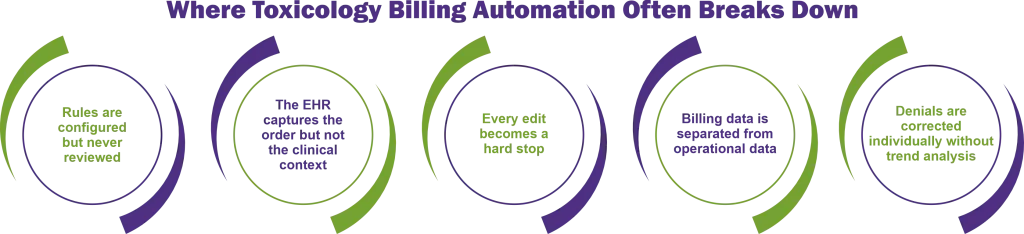
Where Toxicology Billing Automation Often Breaks Down
Automation can improve a laboratory’s revenue cycle, but poorly designed automation can create new problems.
1. Rules are configured but never reviewed
Payer policies and billing requirements can change. A rule that was appropriate when it was configured may need review later.
2. The EHR captures the order but not the clinical context
An electronic order alone does not establish that documentation supports medical necessity.
3. Every edit becomes a hard stop
Not every unusual claim is incorrect. Hard stops can create unnecessary work when a warning and human review would be more appropriate.
4. Billing data is separated from operational data
If the billing team cannot easily see the original order, documentation, test performed, and payer response, claim resolution becomes slower.
5. Denials are corrected individually without trend analysis
Fixing one denial is useful. Identifying why the same denial repeatedly occurs is more valuable.
Periodic medical billing and coding audits can help identify recurring coding, documentation, and workflow issues that may be contributing to denials or underpayments.
Turning Denial Data Into Better Billing Rules
An independent laboratory should use its denial history to improve its front-end workflow. Suppose a laboratory repeatedly receives medical necessity denials for a particular payer and test category. The billing team can analyze:
- Payer
- CPT or HCPCS code
- Diagnosis combinations
- Ordering provider
- Test type
- Documentation available at submission
- Denial reason
- Appeal outcome
If the same problem appears repeatedly, the solution may belong upstream. Instead of asking:
“How do we appeal this denial?”
Ask:
“What change would prevent this claim from becoming a denial in the first place?”
That shift turns the revenue cycle from a reactive process into a feedback system.
Independent Laboratory Revenue Cycle Management Should Connect the Entire Workflow
For an independent laboratory, revenue cycle management extends beyond claim submission. A complete process can include:
Order intake
The laboratory receives and validates the order.
Charge capture
The performed service is accurately reflected in the billing system.
Coding validation
CPT/HCPCS and diagnosis information are reviewed against the service and applicable rules.
Claim scrubbing
Potential coding, payer, documentation, and formatting problems are identified before submission.
Submission
Clean claims are transmitted through the appropriate channel.
Payment posting
Payments, adjustments, and remittances are accurately recorded.
Denial management
Unpaid or denied claims are categorized and routed for appropriate action.
A/R follow-up
Outstanding balances are prioritized based on payer, age, value, and likelihood of recovery.
Trend analysis
Recurring denial patterns are fed back into the billing workflow. This end-to-end approach is particularly important for independent laboratories because billing problems can occur at several different stages. RCM Experts’ laboratory medical billing services cover laboratory-specific billing workflows, including claim management, coding, documentation support, and revenue cycle optimization.
Once claims move into aging A/R, medical claims A/R recovery services can help prioritize outstanding balances, perform payer follow-up, address unresolved denials, and pursue older claims.
CMS Laboratory Rules That Billing Teams Should Monitor
Laboratories should maintain a process for reviewing current CMS guidance instead of relying on static billing references. CMS maintains laboratory billing and coding resources through its Clinical Labs Information Center and related Medicare resources.
For toxicology specifically, CMS’s controlled-substance monitoring guidance includes coding and utilization parameters for presumptive drug testing. The applicable policy should always be reviewed before relying on a specific frequency or coverage rule.
This matters because billing teams need to distinguish between:
- Current Medicare requirements
- Medicare Administrative Contractor guidance
- Commercial payer policies
- Contract-specific rules
- Laboratory documentation requirements
A Practical Toxicology Claim Workflow
A laboratory can simplify its process by establishing a consistent pre-submission checklist.
| Checkpoint | Question |
| Order | Was the requested test actually ordered? |
| Documentation | Is the clinical reason documented? |
| Test performed | Does the billed code describe the service performed? |
| Coding | Is the CPT/HCPCS selection appropriate? |
| Diagnosis | Does the diagnosis information support the service? |
| Payer | Are applicable coverage and billing rules satisfied? |
| Bundling | Is there a potential duplicate or bundled service? |
| Frequency | Does the claim require utilization review? |
| Claim scrub | Are technical and coding errors identified before submission? |
| Follow-up | Are denials categorized for future workflow improvement? |
The checklist should be adapted to the laboratory’s services, payer mix, contracts, and applicable policies.
When Should a Laboratory Consider Outsourcing Toxicology Billing?
Outsourcing may make sense when billing complexity begins to outgrow the internal team’s capacity.
Warning signs include:
- A/R continues to age despite increased billing staff
- Denials are corrected but recurring causes remain unresolved
- Staff spend excessive time manually checking payer requirements
- Billing specialists lack laboratory-specific coding experience
- Claim edits are handled inconsistently
- Management lacks visibility into payer performance
- Revenue cycle workload is expanding faster than laboratory volume
Outsourcing does not eliminate the need for internal oversight. The objective is to combine specialized billing expertise with the laboratory’s operational knowledge and existing technology.
Final Takeaway
Toxicology laboratory billing becomes difficult when the clinical order, documentation, coding, payer rules, and revenue cycle operate as separate processes. The strongest workflow connects those pieces before the claim is submitted.
EHR automation can identify missing information, surface potential bundling issues, support claim scrubbing, and route exceptions to experienced billing professionals. But automation works best when it is paired with accurate documentation, current payer requirements, and ongoing denial analysis.
For independent laboratories, the objective is not simply to submit more claims. It is to create a billing process that identifies preventable problems early, handles legitimate exceptions intelligently, and turns denial data into better revenue cycle decisions.
Frequently Asked Questions
Toxicology laboratory billing is the process of coding, submitting, tracking, and collecting payment for laboratory services used to detect drugs, drug classes, or metabolites. It involves coding accuracy, documentation, medical necessity, payer policies, claim edits, payment posting, and denial management.
Presumptive testing generally determines whether a drug or drug class is present or absent, while definitive testing provides more specific identification of substances or metabolites. CMS maintains separate coding guidance for these services.
A claim can face a medical necessity denial when the documentation, diagnosis, testing circumstances, frequency, or billed service does not satisfy the applicable payer’s coverage requirements. CMS requires the medical record to support the diagnosis and the billed service.
CMS introduced CPT 80305, 80306, and 80307 for presumptive drug testing beginning January 1, 2017. The appropriate code depends on the testing methodology and the applicable billing requirements.
An EHR cannot guarantee payment, but properly configured workflows can identify missing information, coding inconsistencies, potential duplicates, and other problems before claim submission.
An EHR cannot guarantee payment, but properly configured workflows can identify missing information, coding inconsistencies, potential duplicates, and other problems before claim submission.