Patient responsibility has become a larger part of practice revenue as deductibles, coinsurance, and other out-of-pocket costs increase. But collecting a copay at check-in is only one part of the process. A practice can have strong point-of-service collections while still carrying significant patient A/R after insurance processes a claim.
Effective athenahealth patient collections require a connected workflow that starts with eligibility verification and estimates, continues through upfront payments and patient statements, and ends with automated reminders and targeted A/R follow-up.
This guide explains how practices can improve front-end collection rates, automate routine patient billing, manage aging A/R, improve billing transparency, and reduce the administrative work associated with patient collections.
Key Takeaways
- Patient collections begin before the appointment, not when a statement is mailed.
- Accurate eligibility and benefit information supports better patient responsibility estimates.
- Collecting appropriate responsibility upfront can reduce downstream patient A/R.
- Statements should be sent promptly after the final patient balance is established.
- Automated reminders can handle routine accounts while staff focus on exceptions.
- Patient A/R should be prioritized by age, balance amount, and account status.
Understanding Athenahealth Patient Collections
Patient collections involve recovering the amounts a patient is responsible for paying after insurance processing and applicable adjustments. Depending on the patient’s coverage and services received, responsibility may include:
- Copayments
- Deductibles
- Coinsurance
- Self-pay charges
- Balances remaining after insurance adjudication
A key distinction is between point-of-service collections and total patient responsibility.
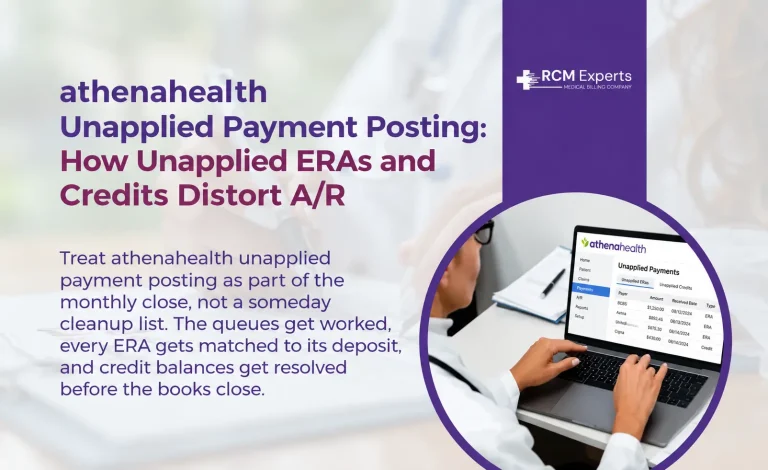
For example, a patient may pay a $40 copay at check-in. After the claim is processed, the payer may apply another $350 to the patient’s deductible. The practice collected successfully at the front end, but it still has $350 in patient A/R to resolve. The reverse also happens: a copay collected but never applied to the visit turns into a credit, which our guide to unapplied ERAs and patient credits in athenahealth covers in detail.
The Athenahealth Patient Collections Workflow
A strong patient collection process follows the patient’s financial journey from appointment scheduling through final payment.
Verify Eligibility and Benefits
Eligibility and benefit verification should happen before the visit whenever possible. Staff should review information that can affect expected patient responsibility, including:
- Active insurance coverage
- Copayment requirements
- Deductible status
- Coinsurance
- Relevant benefit limitations
- Expected patient responsibility
Accurate benefit information gives staff a better basis for discussing costs with patients. Outdated or incorrect information can lead to inaccurate estimates, unexpected balances, and additional collection work.
Estimate Patient Responsibility
Verified benefit information can help the practice estimate what the patient may owe.
An estimate should be presented as expected responsibility, not a guaranteed final charge. The final amount can change after the payer processes the claim based on the allowed amount, deductible, coinsurance, adjustments, and other claim details.
When the final balance differs from the estimate, clear communication helps patients understand why.
Collect at the Point of Service
Practices can collect appropriate copayments and known patient responsibility during scheduling, check-in, or checkout according to their financial policies. The goal is not to guess at the patient’s final responsibility. Staff should collect amounts supported by available benefit information and explain that additional responsibility may be billed after insurance adjudication.
Manage the Balance After Insurance
Once the payer processes the claim, remaining deductible, coinsurance, or other patient responsibility enters the patient billing workflow. Before the balance enters routine patient collections, the practice should confirm that insurance processing, payments, adjustments, and any necessary corrections have been completed.
Improving Front-End Collection Rates
Front-end collections improve when patients understand their expected responsibility before they are asked to pay.
Start Financial Conversations Earlier
Discussing expected responsibility before or during the visit gives patients time to understand and prepare for payment.
Staff can explain:
- What amount is expected now
- Why the amount is due
- What may be billed after insurance
- Where the patient can make a payment
Improve Estimate Accuracy
Better estimates depend on reliable benefit information. Staff should consider the patient’s:
- Eligibility status
- Remaining deductible
- Copayment
- Coinsurance
- Expected allowed amount, when available
An inaccurate estimate can create more work later. If the final balance is substantially different, the patient may question the charge or delay payment.
Make Payment Expectations and Options Clear
Patients should know what is expected of them and how they can pay. Depending on the practice’s enabled athenahealth configuration, payment options may include Patient Portal payments, statement-based payment options, Guest Pay, or other supported digital methods.
Automating Patient Statement Workflows
A statement should be part of a larger collection sequence rather than the first and only attempt to collect a balance.
Send Accurate Statements Promptly
Statements should be sent promptly once the appropriate patient responsibility has been established. Prompt delivery shortens the time between claim adjudication and patient notification and allows the practice to begin follow-up sooner. However, speed should not come at the expense of accuracy. Sending an incorrect balance can create additional questions, disputes, and staff work.
Automate Routine Reminders
Depending on the practice’s enabled configuration, athenahealth can support automated payment reminders through phone, email, text, and/or secure portal messaging. Text messaging requires patient consent. Automation provides consistent follow-up without requiring staff to manually contact every patient.
Route Exceptions to Staff
Automation should handle predictable accounts while staff review situations that require judgment.
An account may need human review when:
- The patient disputes the balance
- Insurance appears to have processed the claim incorrectly
- The balance is unusually large
- A payment arrangement is needed
- The patient requests financial assistance
Managing Uncollected Patient Responsibility
As patient balances age, practices need a consistent way to determine which accounts require additional attention.
Segment A/R by Age, Balance, and Account Status
Age provides the starting point, but balance amount and account status help determine which accounts deserve additional attention.
| A/R Age | Primary Focus |
| 0–30 days | Initial statement and routine reminder |
| 31–60 days | Additional digital outreach |
| 61–90 days | Staff review and targeted follow-up |
| 90+ days | Escalated review based on practice policy |
A $1,500 balance that is 45 days old may deserve more attention than several $25 balances that are only 20 days old. Using both age and dollar amount creates a more practical prioritization method.
Review Account Status Before Escalation
Before escalating an account, staff should confirm:
- Claim status
- Insurance payment and adjustments
- Previous patient payments
- Payment history
- Duplicate or incorrect charges
- Outstanding disputes
Disputed balances should receive separate attention. Patients may question a balance because they expected insurance to cover it, do not understand an adjustment, believe the amount is incorrect, or identify a possible duplicate charge.
Structure Payment Plans
When patients cannot pay the full balance at once, a defined payment arrangement can provide a clearer path to resolution.
Payment-plan terms should identify:
- Installment amount
- Payment frequency
- Payment dates
- Duration
- Missed-payment process
- Required documentation
Payment arrangements should follow the practice’s policies and applicable requirements, with clear terms documented for both the patient and billing team.
Athenahealth Patient Portal and Billing Transparency
Patient billing is easier to manage when patients can quickly understand what they owe, why they owe it, and how they can resolve the balance.
Make Balances Easy to Understand
Patient-facing billing information should make the current amount due easy to identify.
Where available, patients should be able to understand details such as:
- Date of service
- Original charge
- Insurance payment
- Adjustments
- Remaining patient responsibility
This becomes especially important when a patient pays a copay at the visit but later receives a deductible or coinsurance balance.
Make Payment and Billing Support Easy to Access
Patients can use supported options such as Patient Portal, Guest Pay, or Statement Pay, depending on the practice’s configuration. These options give patients ways to resolve balances without always requiring direct staff assistance.
Patients should also have a clear way to contact the billing team when they do not understand or dispute a charge. Self-service can handle routine transactions, but billing questions and disputes still require human support.
Reducing Administrative Cost of Patient A/R
Patient collections require staff time as well as collection activity. If employees spend too much time sending routine reminders or reviewing every small balance manually, less time is available for accounts that need judgment.
Automate Routine Work
Statements, reminders, and standard payment notifications can reduce repetitive manual tasks. Automation is most useful when the account is accurate, undisputed, and does not require special handling. This allows routine accounts to continue through a consistent workflow without repeated manual intervention.
Focus Staff on High-Value Exceptions
Use focused work queues for aging accounts, high-dollar balances, disputes, failed payment plans, and accounts requiring insurance review. This gives staff a defined workload instead of requiring them to manually review every outstanding balance.
Patient Collection Metrics to Track
No single metric provides a complete picture of patient collection performance. Practices should combine front-end, back-end, aging, and bad-debt measures.
| Metric | What It Measures | Why It Matters |
| Point-of-Service Collection Rate | Payments collected around the visit | Shows front-end effectiveness |
| Patient Collection Rate | Patient balances collected | Shows overall patient collection performance |
| Patient Pay Yield | Patient responsibility collected | Shows broader patient collection performance |
| Days to First Statement | Time until patient billing begins | Identifies statement delays |
| Patient A/R Aging | Outstanding balances by age | Shows where A/R is accumulating |
| Collection Rate by Aging Bucket | Performance by A/R age | Identifies where collections deteriorate |
| Bad Debt Rate | Balances becoming uncollectible | Indicates long-term collection gaps |
Common Patient Collection Problems and Solutions : Quick Reference
| Problem | Likely Cause | Recommended Action |
| Low upfront collections | Poor estimates or weak financial conversations | Improve benefit verification and pre-visit communication |
| Growing 30–60 day A/R | Delayed statements or inconsistent reminders | Improve statement delivery and routine outreach |
| Large 90+ day balances | Weak escalation process | Prioritize aging and high-value accounts |
| Frequent billing questions | Poor balance transparency | Improve patient-facing billing information |
| Patients delay payment | Difficult or unclear payment process | Make payment options easier to access |
| Disputed accounts remain unresolved | No separate dispute workflow | Route disputed balances to staff review |
Conclusion
Effective Athenahealth patient collections depend on connecting front-end payment efforts with consistent post-adjudication patient A/R follow-up. Accurate estimates, prompt statements, convenient payment options, automated routine outreach, and targeted A/R management can help practices collect patient responsibility more efficiently.
The goal is not simply to increase collections. It is to create a clearer patient payment process while directing staff time toward the balances that require the most attention.
FAQs
What is athenahealth patient collections?
Athenahealth patient collections refers to the processes used to collect patient-responsible balances, including copays, deductibles, coinsurance, self-pay charges, and balances remaining after insurance processing.
How can practices improve front-end patient collections?
Practices can improve front-end collections by verifying benefits early, providing clearer estimates, discussing expected responsibility before the visit, collecting appropriate amounts upfront, and offering convenient payment options.
How can patient statement workflows be automated?
Practices can use automated statements and payment reminders for routine balances, then route disputed, aging, or high-value accounts to staff for individual follow-up. Available reminder channels depend on the practice’s enabled configuration and applicable requirements.
How should practices manage aging patient A/R?
Practices should segment A/R by age, balance amount, and account status. Routine balances can remain in automated outreach, while older, high-value, disputed, or complex accounts should receive targeted staff review.
How can athenahealth patient billing be made easier for patients?
Practices can improve the billing experience by clearly displaying the current balance, explaining insurance payments and adjustments, providing convenient payment options, and making billing support easy to access.