
Texas is unusually specific about how fast carriers must pay. prompt-pay rules give a carrier thirty days to act on a clean electronic claim and forty-five days on a paper claim, and late payments or qualifying underpayments draw statutory penalties. For a practice running its own billing, those deadlines set the pace for everything else, because every upstream task, eligibility, authorization, coding, documentation, exists to get the claim into that protected window.
The clock is also the smallest item on the list. Around it, a billing office tracks payer-specific eligibility rules, authorization requirements that change plan by plan, coding edits, documentation standards, denial and appeal workflows, and enrollment maintenance. Texas Medicaid keeps revising its layer. The September 2026 TMHP Provider Procedures Manual folded in policy changes effective through October 1, and those changes touched enrollment, prior authorization, claims, reimbursement, and EDI at the same time.
Which brings up the question regional practice owners keep asking. Can a small internal billing operation carry all of this for another year? This guide works through what Texas requires, where the workload concentrates, and how in-house billing compares with outsourced RCM for practices here.
What commercial payer policies in Texas healthcare ask of a billing team
Take one commercial claim and follow it end to end. Benefits get verified, authorization gets obtained, the right CPT or HCPCS or ICD-10-CM codes get attached, documentation gets checked, the 837 file goes out, the EOB comes back, and when the payment runs short or a denial lands, someone researches and appeals it. The steps are the same everywhere. The rules inside the steps are not, because each payer maintains its own versions, and that difference is what multiplies the workload.
The clean-claim condition behind the deadlines
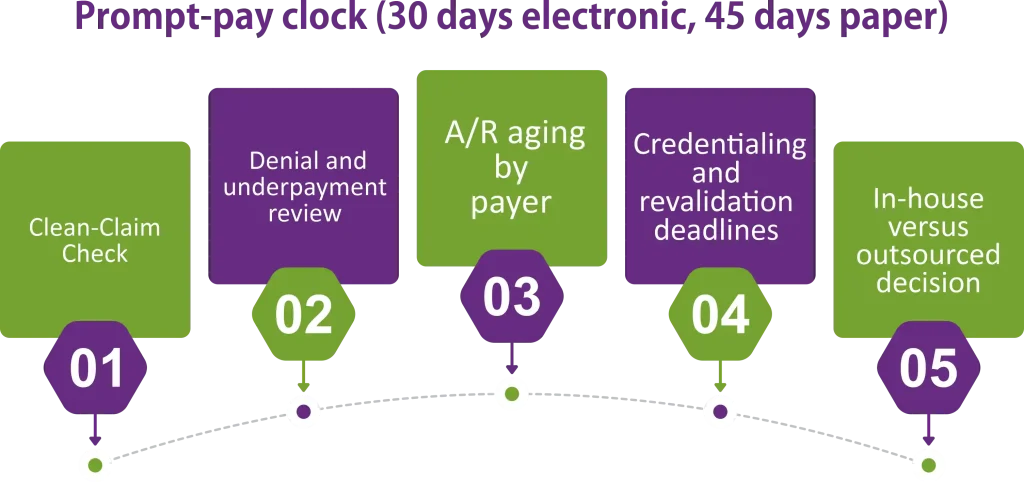
Here is the detail practices miss most often. The thirty and forty-five day deadlines only protect claims that qualify as clean, and clean-claim status depends on the practice’s own front-end work being done correctly first. An incomplete registration, a missing authorization, or a coding error keeps the claim outside the protected window entirely. Clean-claim accuracy is therefore the first metric worth checking in any billing review, ahead of denials or A/R, since everything downstream inherits its quality.
Rate reporting changes the underpayment conversation
TDI has collected health care reimbursement rate data every year since the Texas Legislature authorized the practice under Insurance Code Chapter 38, Subchapter H. The 2026 data call covers qualifying issuers that report at least twenty thousand covered lives to the NAIC, and the rates being reported are for calendar year 2025. What this means at the practice level is that benchmark payment data now exists in published form. An underpayment that once required a consultant’s estimate can be checked against collected figures, which is a good reason to review payment variance routinely instead of treating it as an occasional project.
Why regional practices absorb the pressure first
Organization size explains most of the difference. A large system spreads payer management across departments. A twelve-provider internal medicine group outside Dallas typically runs the whole cycle with one to three people handling eligibility, authorizations, coding, posting, denials, and A/R at once, and credentialing fitted in around the edges by whoever has capacity.
Consider that group’s ordinary month. Four commercial plans, each with its own authorization list. Three Medicaid managed-care organizations, each requiring separate provider enrollment. Daily charge entry, EOBs arriving, and an A/R report that gets a proper read when time allows. Then an authorization fails on one claim. Research takes an hour, correction takes another, and today’s charge entry stacks up behind it. Nothing dramatic went wrong. The workload simply passed the point where the team could stay ahead of it, and the operation shifted from proactive work to reactive work. That shift is the usual breaking point in regional Texas practices. Knowledge is rarely what runs out. Hours are.
Texas Medicaid credentialing requirements
Medicaid enrollment runs on its own schedule through TMHP’s Provider Enrollment and Management System, usually written as PEMS. The practice selects the correct application type, submits documentation, and completes the review. For most providers, revalidation comes due at least every five years, though risk-based categories can shorten that. One detail matters more than people expect: the enrollment is not complete when the forms were submitted. It is complete only when the request reaches Closed-Enrolled status in PEMS.
Why the revalidation deadline does so much damage
TMHP now sends reminders at 180, 120, 90, and 45 days before the due date, and the agency advises beginning revalidation as much as 180 days early. The reminder schedule says a lot on its own. A request that misses the due date gets rejected in PEMS, and the provider must then reenroll from the start, which forfeits reimbursement for any gap in enrollment. Reenrollment costs far more work than revalidation and is entirely preventable with tracked deadlines.
Where enrollment turns into a billing problem
The sequencing is unforgiving. A provider must be enrolled in Texas Medicaid before enrolling with a Medicaid managed-care plan, and enrolled with that plan before its claims will pay. So an enrollment lag is never just a credentialing issue. It becomes unpaid claims on a delay. Credentialing staff and billers need one shared, accurate provider record, and when the two functions run separately, denials show up months after the enrollment step that caused them and nobody connects the two events.
Regional healthcare credentialing bottlenecks
Regional healthcare credentialing bottlenecks form wherever growth outpaces process. Every provider added to the roster means new enrollment applications, new payer participation requests, license and DEA tracking, and another revalidation date to watch. Every new location multiplies the same list. Credentialing work also has no weekly rhythm the way claims do. Its deadlines follow the state’s calendar and tend to surface when nobody in the office is watching for them. In small teams, most credentialing failures trace back to deadline tracking that lived in one person’s memory rather than in a process, and that person eventually took a new job at exactly the wrong time.
Houston and Dallas medical practice billing
Houston and Dallas medical practice billing deal with the same major carriers and the same state rules, but the two markets shape the daily workload differently, and both differ from the smaller cities.
Houston
Houston’s healthcare market is enormous and mixed, with independent practices, specialty groups, hospitals, and academic systems operating within a few miles of each other. Wide payer mix means more payer-specific requirements in play at any moment. Texas Medicaid, commercial plans, workers’ compensation, and self-pay frequently share the same week’s work, and eligibility checking alone starts to need its own schedule.
Dallas
Dallas leans toward larger group practices, and claim volume changes how things fail. At hundreds of claims a day, coding knowledge stops being the constraint. Staff hours are the constraint. Payment posting, denial tracking, and A/R follow-up all grow with claim count, and staffing rarely grows at the same pace.
The smaller markets, Abilene or Beaumont, face neither problem at that scale, but they carry every one of the same rules with fewer hands. The task list does not shrink with the city. The team does.
Outsourced RCM for Texas group practices
So what actually changes under outsourced RCM for Texas group practices? Less than vendor pitches promise and more than skeptics assume. Claim-level repetitive work moves to a team that does it all day, and decisions about the practice’s money stay internal. The right split depends on claim volume, payer mix, staffing capacity, and how much direct oversight leadership wants to keep.
What typically moves out
Eligibility and benefits verification. Charge entry and claim submission. Payment posting. Denial review and appeal preparation. A/R follow-up and claim status checks. Coding review and billing edits. Payer correspondence. Reporting and trend analysis, which in-house teams most rarely have hours to produce. Credentialing support often moves too, particularly where revalidation cycles are stacking up.
What stays under internal oversight
Payer contract negotiation, reimbursement decisions, compliance policy, clinical documentation standards, financial approvals, and access to patient data. An outside team can track and report on all of these, but ownership of them should not transfer.
Full-service versus supplemental support
Full-service RCM fits a practice overloaded across most functions. Supplemental support fits a practice with capable billers and one constrained area, an aging A/R report or a credentialing backlog, for instance. Matching the support to the actual workload, rather than transferring everything by default, is what separates a good outsourcing outcome from an expensive one.
Comparing in-house and outsourced RCM
| Area | In-house RCM | Outsourced RCM |
| Staffing | Hired, trained, and retained by the practice | External team with assigned resources |
| Payer follow-up | Internal billers, between other duties | Specialists working it daily |
| Denials | Reviewed in-house as time allows | Dedicated denial workflow |
| A/R | Monitored internally | Aging accounts worked on a schedule |
| Credentialing | Tracked by internal staff | External help with enrollment and revalidation |
| Oversight | Direct and daily | Practice retains policy and financial control |
Before comparing the two models at all, pull six months of billing data. Anything shorter gives too noisy a picture.
| Measure | What it shows |
| Clean claim and rejection rates | Where claims break on submission |
| Denial volume and top reasons | Which payer rules generate the most rework |
| Days in A/R and aging by payer | How long payment actually takes to arrive |
| Payment variance | Contracted rates versus actual payments |
| Staff hours on billing | The uncounted cost of the in-house model |
| Credentialing workload | Deadline exposure that is not being tracked |
With those figures on one page, the model comparison usually resolves itself. A billing arrangement can look affordable right up until the staff hours spent on eligibility, authorizations, Medicaid enrollment, and reworked claims get priced in. In most cases the data points clearly toward one model for that particular practice, and the debate ends there.
Conclusion
Texas states its expectations plainly. Clean claims get paid in thirty or forty-five days, rates get reported, Medicaid enrollment stays current, and documentation gets kept. What the state does not do is pause while a regional practice hires and trains to meet all of it.
In-house billing remains a sound choice for practices with the staff depth, payer knowledge, and reporting discipline to sustain it. It stops being sound when payer-specific workload outgrows the team, and that point usually arrives without an announcement, visible only in an A/R report nobody opened. Outsourced RCM, applied selectively, amounts to buying back hours for the work only the practice can do. For practices weighing that trade, the Texas medical billing services conversation works best when it starts with your own billing data rather than a contract, because the practices that start there almost always reach the less expensive decision.
FAQs
What are commercial payer policies in Texas healthcare?
The eligibility, authorization, coding, documentation, submission, and appeal requirements each carrier attaches to its claims, together with the state rules around them, prompt-pay deadlines included. A claim has to satisfy the payer’s policy and the statute before it pays.
How do Texas prompt-pay rules affect medical billing?
Carriers generally must act on clean claims within 30 days for electronic submissions and 45 days for non-electronic ones, and statutory penalties attach to late payments and qualifying underpayments. Because only clean claims start the clock, the practice’s own submission accuracy decides whether that protection applies.
What Texas Medicaid credentialing requirements cause the most trouble?
Revalidation. Enrollment runs through TMHP’s PEMS, most providers revalidate at least every five years, and nothing counts until the request reaches Closed-Enrolled status. TMHP’s reminders begin 180 days out because the date sneaks up, and a missed revalidation can force full reenrollment with a reimbursement gap in between.
When should a Texas practice outsource RCM?
When payer follow-up, denials, aging A/R, or credentialing deadlines keep exceeding internal capacity, or when one function needs more hours than the practice can spare. Broad overload points to full-service RCM. A single stubborn backlog points to supplemental help.
How should in-house and outsourced RCM be compared?
With six months of data: clean-claim rates, denial reasons, A/R aging, payment variances, staff hours, and credentialing workload, plus indirect costs like turnover and software. Once those figures sit on one page, the model that fits the actual workload at the true cost is usually easy to see.