Is your practice seeing more patients but collecting cash no faster?
Are billing staff spending their days working aging claims instead of preventing new A/R problems? And if your practice already uses AdvancedMD, are you getting enough value from the platform’s billing, claims, reporting, and workflow capabilities?
Growth can expose weaknesses that were easy to overlook when patient volume was lower. More appointments create more charges, claims, payments, denials, patient balances, and follow-up work. If the internal billing team cannot keep pace, A/R can grow even while the practice appears busy.
AdvancedMD provides an integrated practice-management environment covering areas such as scheduling, billing, claims, reporting, and revenue cycle workflows. RCM Experts also offers AdvancedMD medical billing services for practices that need specialized support working within the platform.
The challenge is not simply having the software. It is making sure the available workflows are configured and used effectively.
Why Patient Growth Can Create an A/R Bottleneck
A practice may assume that higher patient volume automatically means higher revenue. Not necessarily. Every additional encounter creates downstream work:
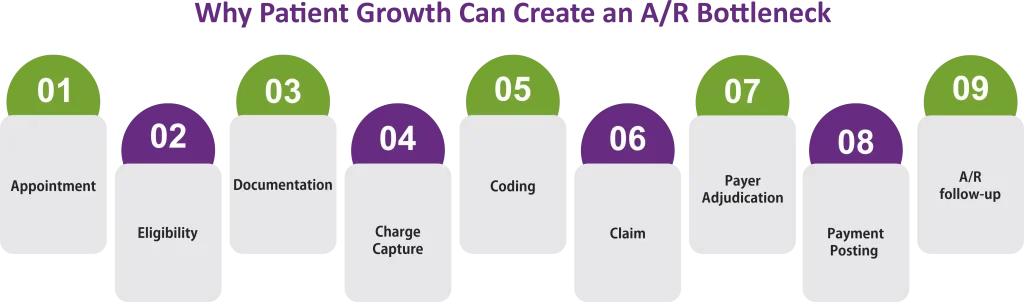
If the front end becomes faster while the billing department remains unchanged, the back end can become overloaded.
Start With the AdvancedMD Workflow, Not More Staff
Before hiring another biller, practice leaders should determine where the bottleneck actually occurs. Is the problem:
- Slow charge entry?
- Eligibility issues?
- Coding errors?
- Claim rejections?
- Unworked denials?
- Delayed payment posting?
- Poor A/R prioritization?
- Patient balance follow-up?
- Lack of management reporting?
AdvancedMD brings several practice-management and revenue cycle functions into an integrated environment. RCM Experts’ AdvancedMD solution page describes support across claims, A/R, clean-claim performance, and cash-flow workflows.
EHR Workflow and Claim Scrubbing Efficiency
One of the most important opportunities is moving error detection earlier in the revenue cycle. If a claim is submitted with an error, the practice may eventually receive a rejection or denial. Someone then has to identify the issue, correct the claim, resubmit it, and monitor the result.
That creates additional work.
A better process attempts to identify problems before submission.
AdvancedMD’s practice-management ecosystem includes claims and billing workflows designed to support claim processing, while RCM Experts’ clearinghouse service includes claim scrubbing, validation, EDI processing, electronic submission, and payer-response tracking.
For practices that need additional coding support before claims enter the submission process, medical coding services can add another review layer.
The practical difference
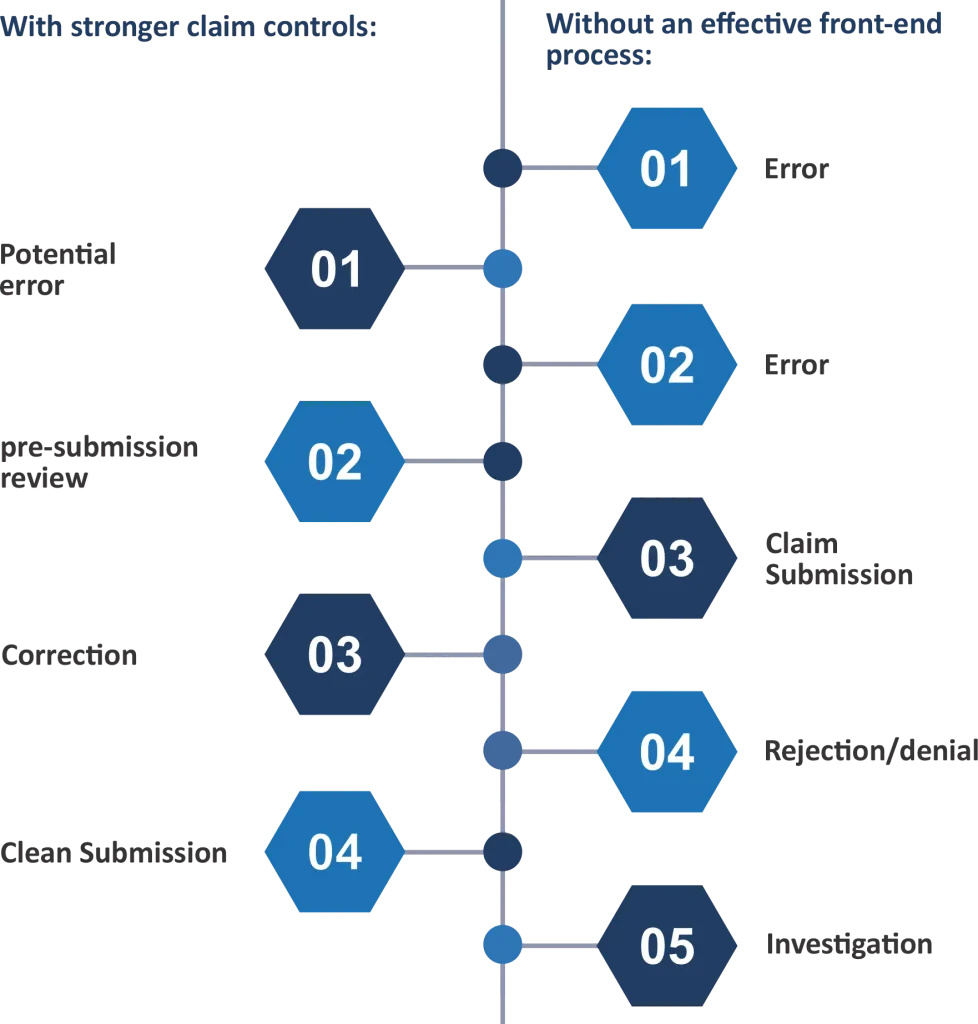
Without an effective front-end process:
Error → claim submission → rejection/denial → investigation → correction → resubmission
With stronger claim controls:
Potential error → pre-submission review → correction → clean submission
The second workflow does not eliminate denials, but it can reduce avoidable rework.
Practices can also strengthen the submission stage through medical billing clearinghouse services, which support claim review, claim scrubbing, EDI validation, electronic submission, payer-response tracking, and rejection management.
What Should Be Included in an AdvancedMD Optimization Review?
An AdvancedMD practice management optimization review should examine more than whether the software is installed and being used.
1. Charge capture
Are completed encounters consistently generating charges?
Missing charges can create lost revenue before a claim is ever submitted.
2. Coding workflow
Are coding issues being identified before claims reach the payer?
The practice should monitor recurring coding-related rejections and denials instead of correcting them one by one.
3. Claim scrubbing
Are available claim-editing capabilities configured appropriately?
A scrubber is most useful when the practice also analyzes which edits occur repeatedly.
4. Eligibility
Are insurance benefits and coverage being verified before services are provided?
When eligibility problems repeatedly appear downstream, practices can evaluate dedicated health insurance eligibility verification services to strengthen the front end.
5. A/R worklists
Are staff working the highest-value accounts first?
Not every outstanding claim deserves the same amount of attention at the same time.
6. Denial management
Are denials categorized by root cause?
A practice should know whether its biggest problems come from eligibility, authorization, coding, documentation, payer processing, timely filing, or another issue.
7. Reporting
Can management see where money is being delayed?
The goal is to connect financial reporting with specific operational decisions rather than simply reviewing monthly collection totals.
Accounts Receivable Reduction With AdvancedMD: Prioritize, Don’t Just Work
A/R reduction is not simply a matter of telling staff to make more calls. The practice needs a prioritization strategy. A useful approach is to segment outstanding balances by:
| A/R category | What to examine |
| Current | Are claims moving through the payer cycle normally? |
| 31–60 days | Are early payer delays or missing follow-ups appearing? |
| 61–90 days | Are unresolved claims becoming a pattern? |
| 91–120 days | What is preventing resolution? |
| 120+ days | Is recovery still realistic, or is escalation required? |
| High-dollar claims | Are valuable accounts receiving priority? |
| Denied claims | What caused the denial and what action is required? |
| Patient balances | Are statements and collection workflows timely? |
The exact thresholds a practice uses can vary. What matters is that the team applies a consistent method.
When aging claims require dedicated attention, medical claims A/R recovery services can help segment outstanding accounts, prioritize high-impact claims, perform payer follow-up, and address unresolved denials.
Stop Treating All Denials the Same
A denial is an outcome, not a root cause. Two claims can both show as “denied” while requiring completely different actions. For example:
Eligibility issue
Verify coverage and correct the claim when appropriate.
Coding issue
Review documentation and coding before resubmission.
Medical necessity issue
Determine whether the documentation and diagnosis support the billed service under the applicable payer policy.
Authorization issue
Determine whether authorization was required and whether an appeal or other payer process is available.
Payer processing issue
Investigate the payer’s adjudication and determine the appropriate follow-up.
For practices dealing with recurring or high-volume denials, denial management services can provide structured denial identification, categorization, root-cause analysis, appeals, resubmissions, and reporting.
Outsourcing vs. In-House Medical Billing: Which Model Fits a Growing Practice?
There is no universal answer. In-house billing can work well when a practice has experienced staff, stable processes, manageable claim volume, effective oversight, and enough internal capacity to handle fluctuations.
Outsourcing can become attractive when patient volume grows faster than billing capacity.
In-house billing
Potential advantages
- Direct control over staff
- Immediate communication with clinical teams
- Existing knowledge of the practice
- Direct oversight of daily billing activities
Potential challenges
- Hiring and retaining experienced staff
- Training requirements
- Coverage during absences
- Managing increasing claim volume
- Keeping up with payer changes
- Limited specialization when the team is small
Outsourced billing
Potential advantages
- Access to specialized billing personnel
- Scalable staffing
- Dedicated denial and A/R workflows
- Broader payer experience
- Less internal administrative management
Potential challenges
- Requires effective communication
- Requires clear reporting
- Requires defined responsibilities
- Requires appropriate vendor oversight
The decision should be based on performance and capacity rather than simply whether outsourcing appears cheaper.
A Better Way to Compare In-House and Outsourced RCM
Instead of comparing only billing fees, calculate the operational cost of the existing model. Consider:
Internal payroll
- benefits
- recruiting
- training
- software and technology costs
- management time
- denial rework
- unworked A/R
- delayed collections
- turnover-related disruption
Then compare that with the total cost and expected operational value of an external RCM model.
For practices already using AdvancedMD, the relevant question is often not whether the platform should be replaced. It is whether internal staff have the capacity and expertise to use the existing environment efficiently.
RCM Experts’ AdvancedMD medical billing services are designed to support billing workflows within the AdvancedMD ecosystem rather than requiring the practice to abandon its existing platform.
How AdvancedMD Can Support a Scalable Revenue Cycle
AdvancedMD’s integrated environment supports practice-management and billing functions across areas such as scheduling, claims, financial workflows, and reporting. RCM Experts also positions its AdvancedMD solution around clean-claim performance, A/R management, and cash-flow support.
The value comes from how these capabilities are configured and used.
Eligibility verification
Identifying coverage problems before the appointment can reduce downstream billing issues.
Charge capture
Connecting clinical workflows to billing can reduce manual data transfer.
Claim scrubbing
Potential problems can be identified before submission.
A/R management
Worklists and financial visibility help billing teams prioritize outstanding accounts.
Reporting
Management can evaluate collections, A/R, claims, payer performance, and other financial indicators.
Centralized billing
For organizations with multiple providers or locations, centralized workflows can improve visibility and coordination.
A Practical A/R Bottleneck Audit
Practice managers can conduct a monthly review using five questions:
1. Where is work accumulating?
Find the stage with the largest backlog.
2. What is causing the backlog?
Separate volume problems from process problems.
3. Is the problem recurring?
If the same denial or rejection appears repeatedly, address the source.
4. Can AdvancedMD automate or surface the task?
Review available workflow, worklist, reporting, and claim-management capabilities.
5. Does the practice have enough specialized capacity?
If technology is available but staff cannot consistently work the resulting queues, additional billing capacity may be required.
This approach prevents the practice from responding to every A/R increase with another temporary staffing solution.
When In-House Billing Starts to Strain
Several warning signs can indicate that an internal billing model needs additional support:
- A/R continues to age as patient volume rises
- Billing staff have more claims than they can consistently work
- Denials are being corrected without root-cause analysis
- Payment posting falls behind
- High-value claims remain unresolved
- Staff spend most of their time on reactive work
- Management cannot easily identify payer-specific problems
- Billing staff turnover disrupts collections
- The practice lacks time for process improvement
At that point, outsourcing does not have to mean giving up control. The practice can retain financial visibility while using an external team for specialized billing functions.
Integrating an External Billing Team With AdvancedMD
A successful outsourced model should have clearly defined responsibilities.
| Practice responsibility | Billing partner responsibility |
| Clinical documentation | Claim review |
| Provider workflow | Coding coordination |
| Patient care decisions | Claim submission |
| Operational decisions | Denial follow-up |
| Access to required records | A/R follow-up |
| Policy oversight | Reporting and trend analysis |
For practices with multiple providers or locations, medical billing services for group practices can provide additional support for claims, coding, denial management, A/R follow-up, and reporting. RCM Experts lists group-practice billing among its current service offerings.
How RCM Experts Can Support AdvancedMD Practices
For a growing practice, the question is not simply whether AdvancedMD has the necessary tools. The more important question is whether those tools are being used consistently across the revenue cycle.
RCM Experts provides AdvancedMD medical billing services designed to work within the AdvancedMD environment, supporting claims, billing workflows, A/R, denials, and revenue cycle performance.
An external team can help practices focus on exceptions that require experienced intervention while using the platform’s existing capabilities to organize routine work.
Final Takeaway
AdvancedMD can provide a strong technology foundation for growing practices, but software alone does not eliminate A/R bottlenecks.
The real opportunity comes from connecting workflow capabilities with disciplined billing processes, accurate documentation, claim validation, denial analysis, A/R prioritization, and meaningful financial reporting.
When patient volume increases, the objective should not be to make the billing team work harder. It should be to make the revenue cycle easier to scale.
For some practices, that means optimizing existing in-house workflows. For others, it means combining AdvancedMD with specialized outsourced billing support.
Either way, the best starting point is the same: identify exactly where A/R is getting stuck, determine why, and fix that part of the workflow first.
Frequently Asked Questions
What is AdvancedMD practice management?
AdvancedMD practice management is part of an integrated healthcare technology environment that supports practice operations and revenue cycle workflows. AdvancedMD’s platform includes practice-management and billing capabilities, while RCM Experts provides billing support for practices using AdvancedMD.
Can AdvancedMD help reduce accounts receivable?
Technology can help organize billing workflows, claims, reporting, and A/R management, but results depend on configuration, staff processes, payer behavior, and consistent follow-up.
What causes A/R to increase as a practice grows?
A/R can increase when patient volume grows faster than billing capacity, claim errors increase, denials remain unresolved, payment posting falls behind, or payer follow-up does not keep pace with new claims.
Is outsourcing medical billing better than keeping billing in-house?
Neither model is universally better. The appropriate choice depends on billing volume, staff expertise, technology utilization, A/R performance, management capacity, and the total cost of the current workflow.
What should a practice monitor to reduce A/R?
A/R aging, days in A/R, denials, rejections, outstanding claims, unbilled services, payment posting turnaround, payer performance, and patient balances are useful areas to monitor.
When should a practice consider outsourcing billing?
Outsourcing should be considered when billing volume exceeds internal capacity, A/R continues to age, denial follow-up is inconsistent, or the practice lacks specialized resources to manage the revenue cycle effectively.
Can an outsourced billing team work within AdvancedMD?
An outsourced billing team can work with a practice’s existing technology environment when appropriate access, responsibilities, security controls, reporting requirements, and workflow ownership are established in advance. RCM Experts specifically offers AdvancedMD billing support.