Can your practice prove every Remote Patient Monitoring (RPM) service it bills? Incomplete consent records, missing device data, weak time logs, and gaps between clinical notes and claims can create denials or audit concerns. Current remote patient monitoring billing guidelines require practices to connect patient care, device data, and treatment management with supporting documentation. CMS states that RPM requires an internet-connected medical device that digitally transmits health data for at least 2 days during a 30-day period.
Integrating RPM workflows gives clinical and billing teams a clearer record of patient enrollment, device use, transmitted data, treatment management, communication, and time. CMS continues to identify CPT 99453, 99454, 99457, and 99458 as RPM codes, with 99457 covering the first 20 minutes of RPM treatment-management services in a month and 99458 covering additional 20-minute periods. However, disconnected EHR, RPM, and billing workflows can leave important evidence difficult to verify.
This guide explains how to build RPM workflows that support documentation, coding, billing, and compliance in 2026. CMS’s CY 2026 Physician Fee Schedule also includes changes affecting remote monitoring payment methodology, making current workflow and documentation controls important for practices reviewing their RPM processes.
What Makes RPM Documentation Audit-Ready?
Audit-ready RPM records should show why monitoring was needed, how the patient entered the program, and what services were actually furnished.
Each record should connect clinical need, consent, device use, transmitted data, and patient education to the billed service.
Clinical Need and Patient Eligibility
Document the acute or chronic condition requiring monitoring and the clinical reason RPM is appropriate. Medicare guidance requires an applicable condition and an internet-connected device that meets the FDA definition of a medical device and digitally transmits physiologic data.
The record should clearly identify:
- Patient diagnosis and medical need
- RPM enrollment date
- Relevant clinical assessment
- Device assigned to the patient
- Provider responsible for RPM services
Patient Consent and RPM Enrollment
Record patient consent when RPM services are furnished. The documentation should identify the service discussed and establish that the patient agreed to participate. CMS permits consent to be obtained at the time RPM services are furnished.
Keep the consent record with the RPM episode so billers and compliance staff can verify it before claim submission.
Device Setup and Patient Education
For CPT 99453, document the initial device setup and education provided to the patient or caregiver. Include the device type, setup date, instructions provided, and confirmation that the patient understood how to use and transmit readings. CMS identifies education/setup, device supply, and treatment management as the three core RPM components.
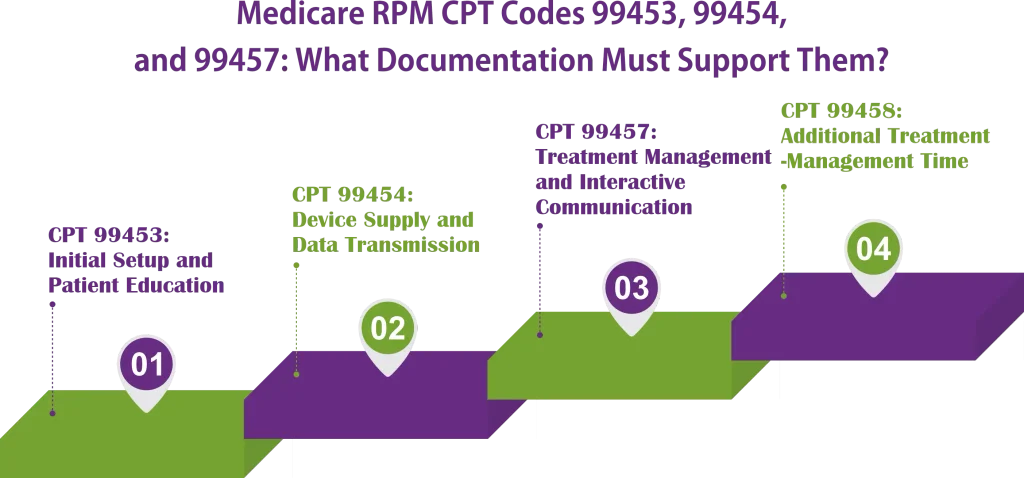
Medicare RPM CPT Codes 99453, 99454, and 99457: What Documentation Must Support Them?
Each RPM code represents a different service, so the medical record should show exactly what was performed and when.
For billers and CPCs, matching the clinical record to the billed code is a key control for preventing Medicare audit flags in RPM.
CPT 99453: Initial Setup and Patient Education
Document the initial device setup and patient or caregiver education. The record should identify the device, setup date, instructions provided, and confirmation that the patient received guidance on using and transmitting data. CMS recognizes education and setup as one of the three main RPM components.
CPT 99454: Device Supply and Data Transmission
Documentation should support the device supplied and its ability to collect and electronically transmit physiologic data. CMS billing guidance identifies **16 or more days of data during a 30-day period** for CPT 99454.
Keep evidence such as:
- Device assignment and activation
- Transmission records
- Applicable reading dates
- Data-monitoring period
- Device-related issues and resolution
CMS also states that RPM devices must meet the applicable medical-device requirements and transmit data electronically rather than rely on patient self-reporting.
CPT 99457: Treatment Management and Interactive Communication
CPT 99457 covers the first **20 minutes** of RPM treatment-management services in a calendar month and requires interactive communication with the patient or caregiver. Document the time, data reviewed, clinical assessment, communication, and resulting treatment action.
CPT 99458: Additional Treatment-Management Time
CPT 99458 applies to each additional 20 minutes of qualifying treatment-management time. Record each activity and its duration so the monthly total can be verified before billing.
How to Document the 20-Minute Monthly RPM Time Requirement
For CPT 99457, the record must show qualifying treatment-management work and the required interactive communication during the month.
A clear time log helps CPCs and billers verify the total before billing and reduces unsupported time entries that can trigger review.
Record Each Billable Activity
Record each qualifying RPM treatment-management activity with its **date, duration, service performed, data reviewed, and patient communication**. Note any clinical decision, medication-related discussion, care-plan adjustment, or follow-up resulting from the reviewed data.
A useful time log can include:
- Date and start/end time or duration
- Physiologic data reviewed
- Patient or caregiver communication
- Clinical assessment or treatment action
- Staff member performing the service
- Cumulative monthly time
CMS identifies CPT 99457 as the first 20 minutes of RPM treatment-management services in a month, including interactive communication with the patient or caregiver.
Avoid Duplicate Time
Do not count the same activity under multiple services or overlapping time entries. Review clinical notes, RPM platform logs, and billing records together before the claim is submitted.
This is especially important when several staff members participate in RPM. Each entry should make clear **who performed the work and what service was provided**.
Reconcile Monthly Time Before Billing
At month-end, compare the time log with the clinical record and billing worksheet. Confirm that the documented activities support the applicable RPM code and that the required communication occurred.
This final review supports “20-minute monthly time tracking billing rules”, strengthens value-based care billing compliance, and gives the practice a clear record if Medicare reviews the claim.
Preventing Medicare Audit Flags in RPM
Medicare has identified concerns involving incomplete RPM services and improper billing.
Practices should use pre-bill checks to identify missing evidence before claims are submitted.
Missing RPM Components
CMS identifies three core RPM components: setup and education, device supply and data transmission, and treatment management.
Review the patient record to confirm that the billed service has the required supporting evidence.
Insufficient Device Data
The record should show that the patient used a qualifying connected medical device and that physiologic data was digitally transmitted for provider review.
Missing transmission records can make it difficult to support the billed device-supply service.
Weak Medical-Necessity Documentation
Document the condition being monitored and why RPM is clinically appropriate for that patient. The diagnosis, assessment, and monitoring plan should provide a clear clinical basis for the service rather than relying on an enrollment record alone.
Missing Patient Communication Records
For treatment-management services, document qualifying interaction with the patient or caregiver. Include the date, communication method, subject discussed, relevant RPM data, clinical assessment, and any treatment decision or follow-up.
Unsupported Time Reporting
Time-based RPM services require documentation that supports the reported monthly time. Record the activity and duration, then review the cumulative total before billing. Do not count duplicate or overlapping work.
Inconsistent Enrollment or Billing Patterns
Review sudden increases in RPM enrollment, unusually high billing volumes, repeated documentation patterns, and patients with limited supporting activity.
A periodic compliance review can identify unusual patterns before they create larger claim problems.
Claim and Clinical Record Mismatches
The submitted code, units, date, diagnosis, and patient information should agree with the clinical and RPM records.
When a claim does not match the underlying documentation, correct the record or claim before submission rather than relying on post-payment corrections.
How RPM Supports Value-Based Care and Revenue Cycle Compliance
RPM creates clinical and billing evidence that can support ongoing patient management, but that evidence must remain accurate and service-specific.
Strong documentation helps practices support appropriate reimbursement while reducing denials, rework, and compliance exposure.
Connecting RPM With Chronic Care Management
RPM and Chronic Care Management (CCM) can support the care of patients with ongoing conditions, but they are separate services with different requirements.
Before billing both, confirm that each service meets applicable Medicare and payer rules and that time or activities are not counted twice.
Preventing Lost Revenue From Documentation Gaps
Missing device records, incomplete treatment notes, or unsupported time can prevent an otherwise billable service from being submitted correctly.
A documentation review before billing can identify these gaps and support appropriate chronic care management revenue recovery without billing for services that lack required evidence.
Supporting Value-Based Care Billing Compliance
Value-based arrangements depend on reliable clinical and reporting data. RPM records can help demonstrate patient monitoring, follow-up, and care decisions when those activities are relevant to the applicable program.
Keep RPM documentation consistent with the payer contract and reporting requirements.
Reducing Avoidable Denials and Rework
A pre-bill review can compare the clinical record, RPM platform data, coding, and claim information before submission. Check:
1. Patient eligibility and applicable payer rules
2. Device and transmission evidence
3. Required communication
4. Documented treatment-management time
5. Code, units, dates, and diagnosis
6. Supporting clinical notes
Conclusion
Audit-ready RPM starts with accurate clinical documentation and continues through coding, claim submission, payment, and follow-up. Following current remote patient monitoring billing guidelines helps teams connect each billed service to clear supporting evidence.
For physicians, RPM teams, CPCs, and billers, consistent records can reduce documentation gaps, prevent avoidable denials, and support appropriate reimbursement. Regular pre-bill reviews also help identify missing device data, communication records, and time documentation.
As RPM programs grow, practices should keep clinical, technology, compliance, and RCM teams aligned. A clear documentation process gives every billed service a verifiable record and strengthens long-term billing compliance.
FAQs
What are the key remote patient monitoring billing guidelines for Medicare?
Key requirements include a qualifying medical condition, an appropriate connected medical device, patient consent, required device data transmission, and documentation supporting the RPM service billed. Each claim should match the clinical record and applicable Medicare requirements.
What documentation is needed for CPT 99453, 99454, and 99457?
CPT 99453 requires documentation of initial device setup and patient education. CPT 99454 requires support for the device supply and qualifying data transmission. CPT 99457 requires treatment-management documentation, including qualifying interactive communication and the required monthly time.
How should the 20-minute RPM time requirement be documented?
Record each qualifying activity with the date, duration, service performed, data reviewed, patient communication, and clinical action. Before billing, reconcile the monthly total and remove duplicate or overlapping time.
What can trigger Medicare audit flags in RPM billing?
Common risk areas include missing RPM components, insufficient device data, weak medical-necessity documentation, missing patient communication records, unsupported time, unusual billing patterns, and mismatches between claims and clinical records.
Can RPM and Chronic Care Management be billed in the same month?
RPM and CCM may be reported together when each service independently meets applicable Medicare and payer requirements. Practices should keep the services clearly documented and avoid counting the same time or activities for both services.