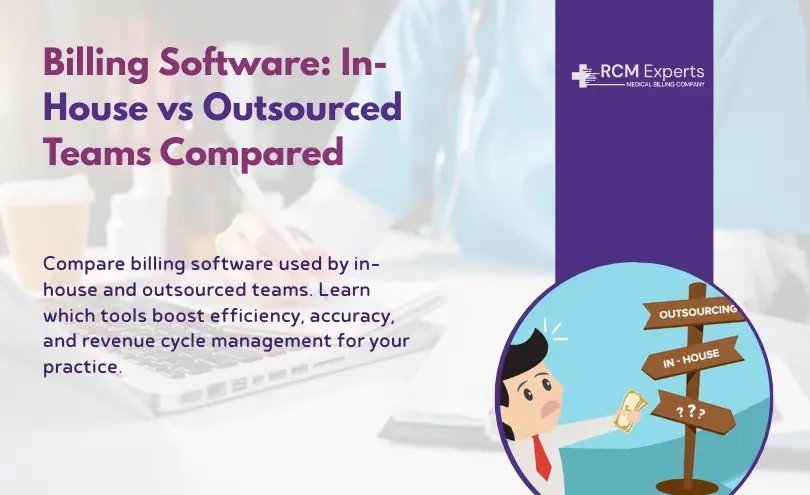
In today’s complex healthcare environment, the right technology can make or break a medical practice’s revenue cycle management. Both in-house billing teams and outsourced medical billing companies rely heavily on specialized software to manage claims, coding, denials, and payments efficiently. However, the software needs, capabilities, and costs differ significantly between the two models.
This article explores the key billing software solutions used by in-house and outsourced teams, compares their features, and highlights the impact of technology choices on billing accuracy, efficiency, and compliance.
Billing Software for In-House Teams
In-house billing departments typically use standalone or integrated software tailored to their specific practice needs. These systems offer flexibility but require significant investment and ongoing maintenance.
Common Software Options
| Software | Description | Pros | Cons |
| EHR Integrated Billing (e.g., Epic, Cerner) | Combines patient records with billing functions | Seamless data flow, reduces manual entry | Expensive, complex to implement |
| Standalone Billing Software (e.g., Kareo, AdvancedMD) | Focuses on billing and claims processing | User-friendly, customizable, scalable | Requires staff training, updates |
| Coding Software (e.g., 3M, Optum360) | Helps coders assign accurate ICD-10 and CPT codes | Improves coding accuracy, reduces errors | Costly licenses, learning curve |
In-House Technology Considerations
- Upfront and recurring software licensing fees
- Need for IT support and system upgrades
- Training staff to use multiple platforms effectively
- Risk of system downtime impacting billing cycles
- Compliance with HIPAA and other regulations
Billing Software Used by Outsourced Medical Billing Companies
Outsourced billing companies invest heavily in enterprise-grade software solutions designed to handle large claim volumes across specialties and payers. These platforms prioritize automation, analytics, and integration.
Leading Outsourced Billing Platforms
| Software | Description | Benefits |
| Athenahealth | Cloud-based RCM with integrated practice management | Real-time claim status, e-prescribing, patient portals |
| eClinicalWorks | Comprehensive EHR and billing combined | Telehealth ready, compliance monitoring, interoperability |
| NextGen Healthcare | All-in-one EHR and billing | Customizable workflows, automated denial management |
| Proprietary Systems | Custom software developed by billing companies | Tailored features, faster updates, scalable infrastructure |
Advantages for Outsourced Teams
- Access to cutting-edge tools without direct cost to clients
- Advanced analytics for denial tracking and revenue optimization
- Seamless interoperability with multiple EHRs and payer portals
- 24/7 system monitoring and cybersecurity management
- Continuous software updates ensuring compliance
Comparing Software Impact on Billing Outcomes
| Factor | In-House Billing Software | Outsourced Billing Software |
| Cost to Practice | High (licenses, IT, training) | Included in service fees |
| Implementation Time | Weeks to months | Minimal for client, managed by vendor |
| Scalability | Limited by hardware and staff | Easily scales with volume |
| Automation Level | Moderate | High with AI and machine learning |
| Denial Management | Manual or semi-automated | Fully automated with analytics |
| Compliance Updates | Practice responsibility | Managed by billing company |
Outsourced billing firms like RCM Experts provide clients with the latest technology as part of their service, reducing the burden on practices to maintain and upgrade expensive software.
Conclusion
The choice of billing software significantly affects revenue cycle efficiency, error reduction, and compliance adherence. While in-house billing teams may benefit from customization and control, they face higher costs and operational risks tied to technology management. Conducting an in-house cost analysis vs. outsourced billing helps healthcare providers evaluate these trade-offs clearly—factoring in software expenses, staffing, and long-term scalability.
Outsourced billing companies leverage sophisticated, scalable, and automated software solutions to optimize claims processing and reimbursement. For many practices, partnering with an outsourced provider means gaining access to superior technology without the capital investment or maintenance headaches.
FAQs
Q1. Can in-house teams use outsourced software?
In some cases, yes, but integration and licensing costs can be prohibitive.
Q2. How often do billing software systems update?
Typically quarterly or in response to regulatory changes.
Q3. Are outsourced billing platforms secure?
Yes, they must comply with HIPAA and use advanced encryption and monitoring.
Q4. Does software choice affect claim denial rates?
Significantly—automated systems reduce errors and expedite re-submissions.Q5. Can software handle multi-specialty billing?
Leading outsourced platforms are designed for diverse specialties and payer requirements.