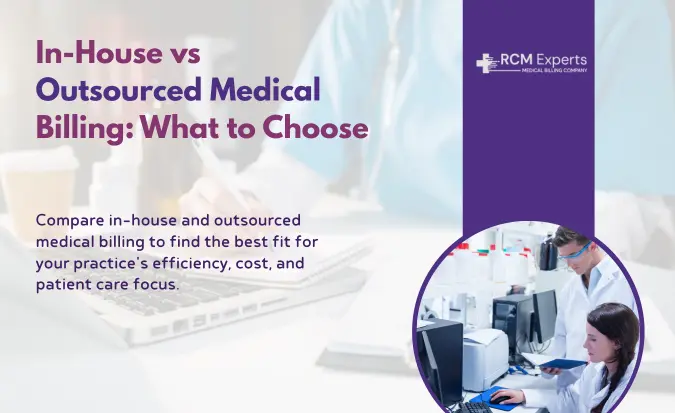
Running a healthcare practice means juggling a lot of moving parts—but one area you can’t afford to get wrong is medical billing. Done well, it ensures healthy cash flow and fewer headaches. Done poorly, it can delay payments, frustrate patients, and drain your resources. Outsourcing Cost Analysis involves assessing both visible and hidden expenses of delegating tasks to third parties. It helps businesses compare in-house costs with outsourcing to determine potential savings, efficiency gains, and risks. This evaluation supports smarter, more strategic decision-making.
So, the big question is: Should your practice manage billing in-house or outsource it to a third-party provider? In this article, we break down the pros and cons of each approach to help you decide what’s best for your practice.
What Is In-House Medical Billing?
In-house billing is when your team handles all billing tasks internally—submitting claims, managing denials, following up with insurance companies, and more.
Pros of In-House Billing
In-house medical billing gives your practice complete control over the entire revenue cycle process. You can manage workflows, prioritize claims based on urgency, and maintain a close connection to billing operations. Internal communication is also more efficient—your front desk, providers, and billing staff can quickly coordinate to resolve issues or clarify information. Another key advantage is the ability to customize billing systems and processes to match your practice’s unique needs, allowing for a tailored approach that aligns with your workflow and patient volume.
Cons of In-House Billing
Despite its advantages, in-house billing comes with significant challenges. One of the biggest drawbacks is the high cost of staffing—including salaries, benefits, and continuous training for your billing team. There’s also the risk of disruption if a key team member leaves, which can slow down operations and impact cash flow. Additionally, maintaining your own billing system requires ongoing investment in secure, up-to-date software, along with IT support and compliance updates—all of which add to the complexity and overhead costs of managing billing internally.
What Is Outsourced Medical Billing?
Outsourced billing is when a third-party company handles all aspects of your billing—from claim submission to payment posting, and even patient collections.
Pros of Outsourced Billing
Outsourced billing offers businesses a cost-effective way to manage their financial operations by eliminating the need for in-house billing staff, training, and software expenses. It allows access to industry experts who ensure accuracy, reduce errors, and maintain compliance with the latest regulations. This not only minimizes claim denials but also improves cash flow through faster reimbursements.
By outsourcing, companies can shift their focus to core functions such as customer service or patient care, boosting overall productivity and service quality. It also reduces administrative burden and enhances operational efficiency. Another key benefit is scalability—outsourced services can easily adjust to fluctuations in workload, making them ideal for growing businesses. With reduced overhead and improved billing accuracy, outsourcing becomes a strategic move for long-term success.
Cons of Outsourced Billing
While outsourced billing can offer efficiency and cost savings, it also comes with potential drawbacks. One of the main concerns is the loss of direct control over billing operations, which can lead to delays in communication and difficulty in making quick adjustments. Relying on a third-party provider may also pose data security risks, especially if the vendor does not have strong privacy and compliance measures in place. Additionally, the quality of service may vary, and errors can still occur despite outsourcing to professionals. Some businesses face challenges with customization, as external teams may not fully understand their specific needs or workflows. Hidden costs and rigid contracts can also become issues if not carefully reviewed. Time zone differences and language barriers may further complicate coordination.
Cost Breakdown: In-House vs Outsourced
| Category | In-House Billing (Solo Practice) | RCM Experts Billing & Audit Cost |
| Employee Salary (per month) | $2,860.00 | $1,906.00 |
| Medical Benefits | $272.50 | None |
| Sick Leave | $66.00 | None |
| Vacation Leave | $55.00 | None |
| Retirement Plan (Simple IRA) | $85.80 | None |
| Workers Compensation | $27.17 | None |
| Payroll Taxes (estimated) | $219.16 | None |
| Practice Management Software | $300.00 | Included |
| Electronic Claims Submission Fee | $35.00 | Included |
| Paper Claims (Supplies & Postage) | $40.80 | Included |
| Patient Statements (Supplies & Postage) | $36.50 | Included |
| Total Monthly Cost | $3,997.93 | $1,906.00 |
How to Choose What’s Right for Your Practice
Every practice is different. Here are a few key questions to guide your decision:
1. What’s the size of your practice?
- Small practices often find outsourcing more cost-effective.
- Larger practices may benefit from building an in-house team to handle volume efficiently.
2. Do you have experienced billing staff?
- If not, outsourcing can ensure accuracy and faster reimbursements.
3. How much control do you need?
- If real-time oversight is a priority, in-house might be the way to go.
4. What’s your budget?
- Outsourcing offers predictable costs and less operational stress.
- In-house requires investment but offers more customization and internal ownership.
Hybrid Model: The Best of Both Worlds?
Some practices blend the two approaches—keeping front-office billing functions like patient registration or copay collection in-house, while outsourcing claim submission and follow-up.
This hybrid setup can offer both control and efficiency, depending on your workflow and team capacity.
Final Thoughts
Choosing between in-house and outsourced billing isn’t a one-time decision—it’s a strategic one that impacts your revenue cycle, team workload, and patient satisfaction.
To recap:
- In-house billing gives you more control but demands more resources.
- Outsourcing offers convenience and expertise, but with less visibility.
- Hybrid models offer flexibility if you want to balance both.
Ultimately, the best choice is the one that helps your practice run smoother, get paid faster, and focus more on what matters most: patient care.
Ready to Improve Your Billing Workflow?
If you’re exploring outsourced billing services or want help optimizing your current process, we’re here to help.
Contact us today to schedule a free consultation—or learn more about our tailored medical billing solutions.